How To Write Off Business Expenses: What Small Business Owners Need To Know

As a small business owner, you are allowed to deduct certain expenses. However, not every deduction you see online actually exists. According to the Internal Revenue Service’s (IRS) rules, deductible expenses must be ordinary and necessary for the business. To successfully reduce your company’s tax burden, it’s important to understand what counts as a business expense, what it means to write off an expense, common deduction categories, documentation requirements, and commingling errors to watch out for.
What Are Business Expenses?
Business expenses are any costs a business incurs to operate and generate revenue. This includes paying for your company’s rent, supplies, marketing, and payroll. There are many costs included in this category, but not all of them are eligible for a tax write-off. To learn how to write off business expenses, you’ll first need to determine which business expenses can be written off and which ones cannot.
What Is a Write-Off? What Does It Mean To Write Off Taxes?
What is a write-off, and how can you use it in your business? A write-off is an expense that can be deducted from your taxable income. When something can be written off, it effectively works to lower the amount of taxes owed.
It’s important to note that writing something off doesn’t mean that it’s free. Your business still has to pay for the expenses. The difference is that a write-off means you don’t have to pay taxes on the money spent. If you pay a tax rate of 22%, you would roughly save $22 in taxes on $100 in business expenses.
What Actually Counts as a Deductible Business Expense?
The IRS allows businesses to deduct expenses that are both ordinary and necessary. Ordinary means that the expense is something that commonly occurs in the industry you operate in. Meanwhile, a necessary expense is one that is helpful and appropriate for your business and trade.
Despite the common misconception, not every limited liability company (LLC) expense is automatically deductible. There are set rules about what can be deducted and how much. Cars, for instance, aren’t automatically 100% deductible. Instead, businesses can deduct vehicle-related expenses using either the standard mileage rate or the actual expense method. Entertainment expenses are generally not deductible. There are also limitations on deducting business meals.
Additionally, deductions aren’t reserved for profitable businesses. Startups and struggling businesses can still use deductions to lower their taxable income, even if they aren’t actively earning a profit.
Common Expenses for a Business That Can Be Written Off
What are the expenses in a business that can be written off? While each business has different costs, the following are some of the most common expenses for a business to claim on their taxes.
Home Office Deduction
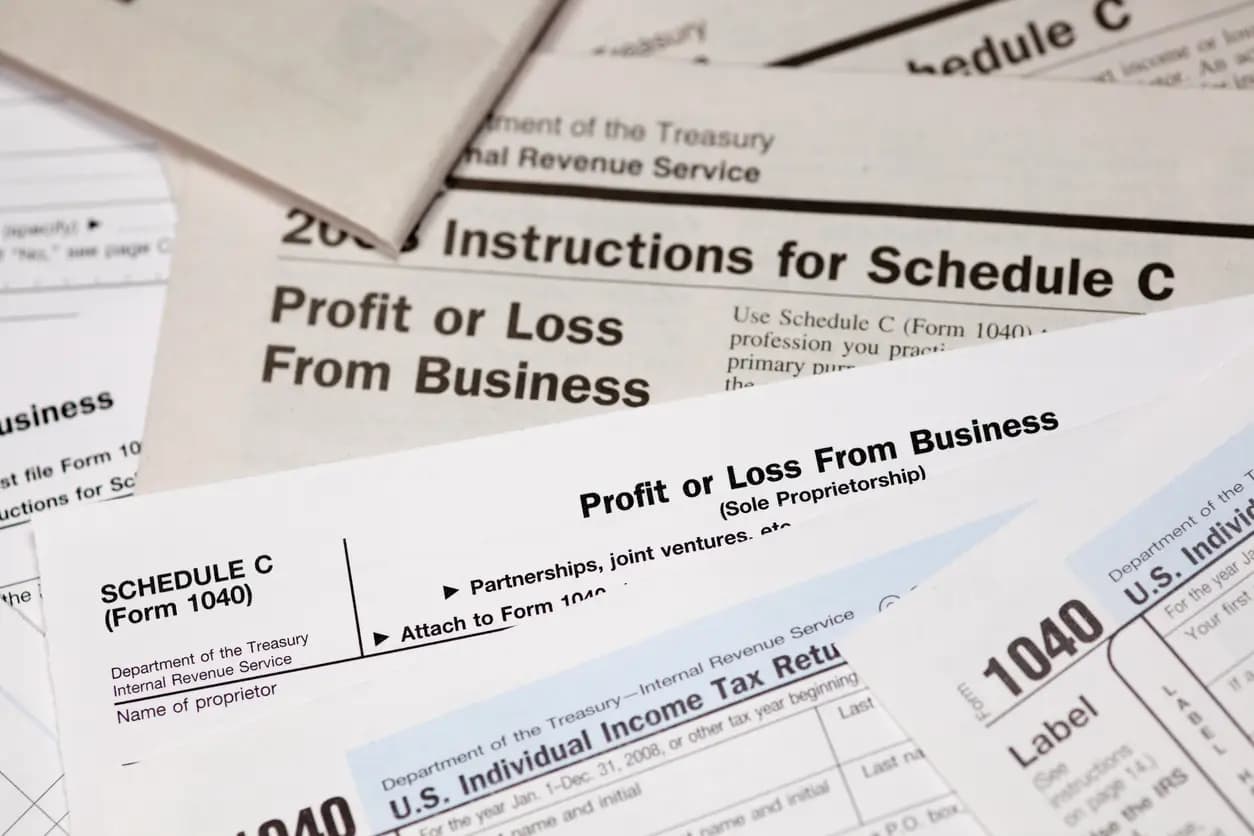
The home office deduction can be taken using the simplified method or the regular method. With the simplified method, you multiply the square footage of your office by $5. Up to 300 square feet can be deducted. The resulting figure is your home office deduction for the entire year. To use this method, you just have to add the square footage on your Schedule C.
because the simplified method hasn’t been increased since it was first adopted in 2013. Under the regular method, you can deduct the percentage of actual home expenses devoted to your home office. This percentage is based on your office’s square footage and reported through Form 8829.
Vehicle Expenses
You can deduct vehicle expenses by using one of two different calculation methods. The standard mileage rate involves deducting a set rate per business mile. Alternatively, you can track and deduct the actual expenses.
No matter what option you use, it’s important to remember that commuting from your home to a regular office doesn’t count as business mileage. If you have to drive between different job sites, deliver a product, or meet clients, the mileage is deductible.
Startup and Formation Costs
Businesses are able to deduct up to $5,000 in startup costs and $5,000 for organizational costs, such as the fees for filing your articles of incorporation. Amounts above this can be amortized over time. Phase-outs begin at $50,000, with a maximum amortized deduction of $55,000.
Marketing and Advertising
Marketing and advertising costs can be deducted from your taxable income. This includes all types of online and offline advertising, such as website costs, business cards, flyers, and social media promotion.
Professional Development and Education
In some cases, your professional development and education can be a business expense. Many business-related workshops, conferences, and professional subscriptions can be deducted. Similarly, books and learning materials related to your business may also be deductible.
Equipment and Section 179 Expensing
Under Section 179 and bonus depreciation, businesses don’t have to spread out the deduction for qualifying equipment over multiple years. Instead, the entire cost can often be deducted in the year of purchase, up to annual IRS limits.
Retirement Contributions and the Pass-Through Deduction
Depending on your business structure, the retirement account type, and how you make the contributions, the amount you contribute to a retirement account may be deductible. For example, many small businesses use solo 401(k)s and SEP-IRAs to save for retirement while lowering their tax burden.
Pass-through businesses, such as sole proprietors, LLC members, and S-corp shareholders, can also take advantage of the qualified business income (QBI) deduction. With the QBI, businesses can deduct up to 20% of qualified business income.

What You Need to Document Every Write-Off
One of the most important things you can do to successfully write off business expenses is to keep careful records. You should store all of your receipts and clearly link each expense with a business purpose. For phones, cars, and other costs that are used for personal and business purposes, you should keep a log that shows the business-use percentage.
The Commingling Mistake That Can Wipe Out Your Deductions
One of the most common mistakes small businesses make is to mix their personal and business funds. When this happens, it becomes much harder to prove that any expense was truly for the business. If you are audited, the IRS auditors will treat it as a red flag. As a result, they may expand the scope of the audit to see if there are other problems present.
If you choose an LLC or corporation as your business entity type, you need to treat it as a separate entity. Your business should have a separate bank account and formal recordkeeping. When business and personal accounts and records become mixed, it risks piercing the corporate veil. Once this happens, it can potentially expose your personal assets if there is a lawsuit or unpaid business debt.
Make Sure Your Entity Is Actually in Good Standing
When it comes to maintaining an LLC or corporation as a separate legal entity, maintaining its registration and status with the state is important. A lapsed business registration, missing reports, or unpaid fees can lead to compliance issues.
To verify that your business is in compliance with the state, you can use EntityCheck’s Secretary of State (SOS) Business Search. This tool makes it easy to confirm that an LLC or corporation’s registration is active and in good standing.
Frequently Asked Questions
What is the difference between a business expense and a tax write-off?
Not all business expenses qualify as tax write-offs. A business expense becomes a write-off when it qualifies for and is claimed as a tax deduction. Fines, bribes, personal expenses, kickbacks, and political contributions cannot be deducted.
Can I write off expenses if my business isn't profitable yet?
Yes, you can. To write off expenses, you must form the business with the intent to seek a profit. There are also specific limitations on how much can be written off initially. During the first year, you can deduct up to $5,000 of your startup costs and $5,000 for your organizational costs. Then, the remainder can be amortized over ensuing years.
If you deduct more than you earn for multiple years, it can become an issue. The IRS generally presumes an activity is carried out for profit if it is profitable for at least three out of the last five years. A business that fails to earn a profit may be considered a hobby, which would change how expenses are treated. However, the IRS can also review other factors when deciding if an activity is a hobby or not.
Do I need a business bank account to claim deductions?
A business bank account is not a legal requirement for claiming deductions. It is, however, a good idea to separate your personal and business finances. Besides making bookkeeping more convenient, separate accounts can help you avoid piercing the corporate veil and opening up potential liability issues.
To claim deductions, you will need to store receipts or invoices for the expenses. Bank records can help substantiate expenses, but they may not be sufficient on their own if you are audited.
What happens if the IRS disallows a deduction during an audit?
When a deduction is disallowed, it can raise your taxable income. Unless something else changes, this will increase the amount you owe in taxes. In addition to a higher tax bill, you may need to pay interest on the additional tax owed and potential penalties. It may also push you into a different tax bracket. Maintaining accurate receipts, mileage logs, and other records can help you avoid this outcome.
Can I deduct 100% of my cell phone bill if I use it for both business and personal calls?
No, you can’t. You also cannot deduct the basic local service charge for the first phone line in your home.
To deduct phone costs, you’ll need to keep notes that show if calls were for business or personal reasons. You can also deduct charges for business-related long-distance calls and roaming charges. Additional services and plan increases can be deducted if they were made specifically for business purposes.
How can I confirm my business entity is in good standing before tax season?
Before tax season, it’s a good idea to verify that your company is in compliance. You can check with your Secretary of State or the applicable agency in your state to see if your business is in good standing. With EntityCheck’s SOS Business Search, you can check your registration information and confirm your business is in good standing.