Search Texas UCC Filings & Liens

A Texas state UCC search identifies public records of security interests or liens filed against a business's personal property (collateral) to secure loans or financing. It reveals whether other creditors have claims to assets such as equipment, inventory, or accounts receivable; essentially allowing lenders to check for existing, competing claims on a borrower's collateral before approving new financing. Texas UCC filings are complex because most are filed with the Texas Secretary of State, but some (such as fixture filings, federal liens, co-op, and judgment liens) are recorded with the county where the business or individual resides. EntityCheck solves the problem with an easy-to-use database that consolidates all UCC data in a single, user-friendly platform and searches for variations with a single search string.
What Is a UCC-1 Financing Statement?
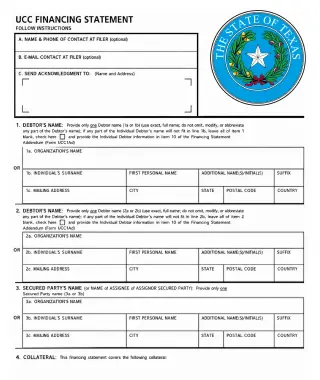
A UCC-1 financing statement is a legal document filed by a creditor (lender) to publicly declare that they have a "security interest" in a debtor's (borrower's) personal property. It acts as a lien on assets, such as equipment, inventory, or accounts receivable, giving the lender first rights to those assets if the loan is not repaid.
What is a UCC-1 Financing Statement? A UCC-1 financing statement is a public notice that establishes a legal claim over specific collateral and prioritizes that creditor in the event of a default or bankruptcy.
Why Does it Give Legal Notice Against Third Parties? A UCC-1 filing in Texas provides legal notice against third parties by creating a public record that perfects a creditor's security interest in a debtor's collateral. Filed with the Texas Secretary of State, this filing serves as "constructive notice" to potential future lenders, buyers, or creditors that specific assets are already pledged, thereby establishing priority under the "first to file" rule.
What "Perfecting a Lien" Means and Why it Matters for Creditors: Perfecting a lien in Texas is the legal process of recording a security interest in a debtor's property (via filing a UCC-1, deed of trust, or mechanic's lien affidavit) to make it enforceable against third parties. It matters to creditors because it establishes legal priority, ensuring they are paid first from the proceeds of a foreclosure or sale, ahead of other creditors.
Where Most Texas UCC Filings Go: In Texas, most Uniform Commercial Code filings, including UCC-1 financing statements, are filed centrally with the Texas Secretary of State (SOS). Over 90% of these filings are processed electronically through the SOSDirect online system.
The Exceptions: The primary exception is for real estate-related collateral, which must be filed with the relevant county clerk. Other exceptions include timber to be cut, minerals, oil, or gas to be extracted, and co-op properties.
What a TX UCC Search Reveals

A Texas UCC search reveals active security interests (liens) filed against a debtor's personal property, which are crucial for evaluating risk, creditor priority, and collateral availability. The details of the data you will find are detailed below:
Debtor Name & Address - Exact legal name and address of the individual or entity borrowing money or leasing equipment so that you can delve deeper during due diligence.
Secured Party Name - The lender or creditor claiming a stake in the assets. This is helpful if you need additional details about the collateral or claim; you can contact the secured party directly.
Collateral Description - Details of the assets covered, ranging from specific items to "blanket" liens covering all business assets (e.g., inventory, equipment, accounts receivable). "All assets" means that all current and future assets are encumbered.
Filing Date - The official date/time the lien was filed, which determines priority (FIFO - first in, first out) when multiple creditors exist.
Lapse Date - The date that the UCC filing expires, typically 5 years from filing, after which an unfiled continuation means the lien is dead.
Filing Number - A unique identifier issued by the Secretary of State for retrieving certified copies or tracking amendments.
Amendments / Terminations - Indicates if the filing is active, terminated, assigned to another party, or continued, using UCC-3 filings.
Assignees - Information on any new lien holders if the original secured party has transferred their interest to another entity.
Why Do UCC Filings Matter in Texas?

Texas is considered a high-volume state for UCC filings, ranking alongside major states such as California, New York, and Florida. In Fiscal Year 2024, the Texas Secretary of State's office processed approximately 662,323 UCC filing transactions. In addition to filings, the office processed around 583,255 requests for information (searches) on existing UCC records in FY2024.
Texas-based lenders file UCC-1 financing statements against borrowers nationwide, making Texas a crucial search jurisdiction, even for out-of-state debtors. Due to significant business growth and economic activity, Texas often serves as a central location for commercial lending and equipment financing that requires UCC-1 filings to establish creditor priority.
However, the UCC filing landscape is complex, with many filings recorded at the state level, but others recorded with county offices. Real estate and co-op transactions rely on county-level UCC filing in Texas searches to find fixture filings (assets attached to real property), judgment liens, and mechanics' liens. Companies involved in M&A due diligence also have to search both state and county resources to get the complete picture before moving forward.
How to Run a TX UCC Search

To run a state of Texas UCC search, follow the detailed steps below:
Step 1: Identify the Correct Debtor Name
A Texas Secretary of State UCC search requires an exact name match. The databases return results based on the debtor name string (or company) with no fuzzy matching. You must enter it correctly to see accurate results. Even a single variation (missing middle initial, a misplaced comma, or a DBA abbreviation) can return zero results when active filings exist. Your first step is to find the debtor's exact name (as it appears on their driver's license or other official documents). For companies, use the name in their formation documents. When searching for individuals, use the legal name format of Last, First, Middle. You can also search by filing number if you know it.
Step 2: Choose Your Search Method
When performing a UCC search in Texas, you have a few options. If your goal is to do research, such as a preliminary review to gather facts, you can use the free, non-certified results through the Texas Secretary of State. The e-filing portal allows you to search and see online results, but if you need certified copies, you will need to order them and pay a fee. You can order searches and certified copies by mail by submitting a written request or Form UCC-11 to the Secretary of State, specifying the debtor's name and file numbers, along with the appropriate fees. Mail the request to: Certifying Team, Secretary of State, P.O. Box 13697, Austin, Texas 78711-3697. You can also use a trusted, authorized search service for the fastest turnaround, which provides up-to-date records and includes both state and county records.
Step 3: Review the Search Results
Step three is an imperative piece of the puzzle. Once you receive the results, review them carefully and verify everything. Check each active filing for the debtor's name and confirm that it is the correct debtor (not a coincidental name match). Review the collateral included and the description to ensure it matches the encumbered assets and whether it lists specific items or "all assets". Check the secured party's identity to ensure it is correct and confirm the filing/lapse dates to ensure the filing is current. Be sure to check all amendments and continuations (UCC-3 forms) as these modify the original filing and may expand the collateral or extend lapse dates. Take note of any termination statements that release liens and flag any assignments where the original lien holder differs from the original filer.
Step 4: Obtain Certified Copies If Required
Certified copies of UCC filings are required in Texas to verify existing liens on assets during due diligence, before closing secured loans, or to initiate legal action regarding collateral. They provide legally recognized proof that the creditor filed with the Texas Secretary of State and are used for lender requirements, court proceedings, or ensuring an accurate UCC record, particularly after amendments or terminations are filed. Non-certified results from the Secretary of State portal are fine for informal research during internal due diligence or preliminary lender review. But in cases where officially stamped documents (by the SOS) are required, you must order them early, as it takes at least 24 hours and sometimes up to 3 days for image copies. You must pay a fee when ordering copies.
TX UCC Search for Out-of-State Businesses
Under the Uniform Commercial Code Article 9, the jurisdictional rule for filing financing statements is determined by the debtor's location, not the location of the collateral. For registered organizations like corporations or LLCs, this generally means the state where they are incorporated, which, for many out-of-state businesses, is not Texas. Therefore, when searching for UCC filings against an out-of-state business, you should begin in the debtor's home state's Secretary of State office.
Despite this, Texas UCC searches remain crucial for out-of-state debtors because a foreign entity "transacting business" in Texas must register with the Texas Secretary of State. If an out-of-state company pledges equipment, inventory, or accounts receivable located within Texas as collateral, or if the company has registered a foreign qualification to operate there, creditors may file financing statements directly in Texas to perfect their security interest. Furthermore, Texas requires UCC filings to be checked for local Texas-specific judgment liens or agricultural liens that might impact assets within the state, regardless of the debtor's home state.
To conduct a Texas UCC search for an out-of-state business, use the Texas Secretary of State's online system, SOSDirect. Search by the exact legal name of the entity to identify active financing statements (UCC-1) or amendments (UCC-3) filed in Texas. If the debtor has a, or is expected to have, Texas-based assets or a "foreign qualification" (registration to do business), searching is essential for comprehensive due diligence to confirm the priority of security interests.
UCC Forms and Filing Duration in Texas

UCC Forms Used in Texas
In Texas, UCC filings are handled by the Secretary of State, and initial UCC-1 financing statements are effective for 5 years from the date of filing. The forms include the UCC-1 (initial filing) and UCC-3 (amendment/continuation), filed via SOSDirect to protect a secured party's interest in collateral. The UCC forms used in Texas are detailed below:
UCC-1 (Financing Statement): Used for the initial filing to perfect a security interest in personal property collateral.
UCC-1Ad (Addendum): Used in conjunction with the UCC1 for additional information like additional collateral.
UCC-1AP - Used to add multiple debtors or secured parties.
UCC-3 (Amendment/Continuation): Used to amend, terminate, or file a continuation to extend the filing.
UCC-5 (Information Statement) - Filed to indicate that a filing is inaccurate or wrongfully filed.
UCC-11 (Information Request): Search request form to search for existing liens against a debtor.
How Long Are Texas UCC Filings Effective?

In Texas, a UCC financing statement is generally effective for five years from the date of filing. This filing acts as a public notice that a lender has a security interest in a debtor's collateral. To keep the filing active beyond five years, a continuation statement must be filed within the six-month window before the expiration date
Standard Lapse: The standard lifetime of a UCC filing is 5 years from the filing date. A lien with no continuation filed before the lapse date is extinguished.
Continuation: Must be filed within the final 6 months before the 5-year expiration to extend for another 5 years. Outside this window, a continuation is ineffective.
Deceased Debtor: A UCC-1 financing statement in Texas remains active for five years from the date of filing, even if the debtor dies. The death does not automatically invalidate the security interest, but creditors must file a claim against the estate and may need to file a continuation statement within six months before the five-year expiration to maintain perfection.
Manufactured Homes: The 30-year lapse period for manufactured homes is the only category that extends beyond the standard 5 years.
"All Assets" Lien: A Texas UCC-1 financing statement, even with a "blanket lien" (all assets), is active for five years from its original filing date. The lien automatically lapses and becomes invalid if not renewed, unless the secured party files a UCC-3 continuation statement within six months prior to the five-year expiration.
What Happens When a TX UCC Filing Lapses

When a Texas UCC-1 financing statement is not continued within the strict six-month window before the five-year anniversary, it lapses, and the security interest immediately becomes unperfected as a matter of law. Consequently, the original secured party loses its senior priority status. It does not automatically retain its Texas rights; it is treated as if it were never perfected against subsequent purchasers for value. To re-establish perfection after a lapse, the lender must file a completely new UCC-1, which resets their priority clock to that new filing date rather than the original one. This creates significant risk, as any intervening creditors who filed after the initial perfection but before the re-filing will gain priority over them. For due diligence, this means a searcher must not ignore a past-lapse-date filing; they must verify whether a valid continuation was filed prior to the expiration date. Ultimately, never assume a filed UCC-1 is legally irrelevant simply because the search results indicate a past lapse date without confirming the absence of a properly filed continuation.
UCC Lien Priority Explained

In Texas, UCC lien priority generally follows the "first-to-file-or-perfect" rule outlined in Section 9-322 of the Texas Business and Commerce Code. This means the first creditor to file a UCC-1 financing statement with the Texas Secretary of State usually has the top priority (first lien position) over all later-filed liens against the same collateral. If no filings exist, the first to attach a security interest wins, but filing offers the strongest, most stable priority.
Several major exceptions to the first-to-file rule include Purchase Money Security Interests (PMSI), often used for equipment, which can take priority if filed within 20 days of the debtor's possession. Other issues include statutory liens (e.g., landlord or materialman liens) that can surpass a previously filed UCC. An inaccurate debtor name renders a filing useless, and a failed continuation statement results in a loss of priority.
Conducting a thorough UCC search is essential because it reveals existing secured creditors and helps identify potential priority traps before a loan closes. A search tells lenders if their collateral is already pledged, allowing them to assess risk, request subordination agreements, or ensure they are properly "first in line". Without this search, a lender risks being second in line, severely impacting their ability to recover funds in a default or bankruptcy.
Who Needs a TX UCC Search
Lenders, investors, buyers, and legal counsel during due diligence are some of the individuals who need a Texas UCC search. They use the search to identify existing liens on a business's personal property or assets. It is essential for verifying collateral availability, understanding creditor priority, and ensuring a clear title before completing financial transactions.
Lenders and Financial Institutions

Before approving loans, lenders (commercial banks, asset-based lenders, factoring companies, and equipment lenders) run a UCC search to confirm if a debtor's assets (e.g., equipment, inventory) are already pledged to another creditor. Lenders need to secure the top priority position to protect their investment. That means they will be paid first if the borrower defaults or files for bankruptcy. Due to the inherent risk, lenders must conduct thorough due diligence, including both state and county offices. EntityCheck streamlines this process by aggregating data from both database types. Relying on EntityCheck ensures a quick turnaround and helps close on time.
Attorneys and Legal Professionals

Attorneys conduct searches to evaluate potential risks and ensure that their clients' security interests will have priority in case of default. This applies to M&A attorneys, bankruptcy attorneys, real estate attorneys (for commercial closings), and litigation attorneys identifying encumbrances on judgment debtors. The risk here is failing to discover hidden liens that cause post-closing liabilities or inherited liens. It can affect priority schedules if not managed properly. The key is to search all locations simultaneously using an authorized search service like EntityCheck, which displays results from both state and county sources.
Businesses and Buyers

When buying a business, a UCC filing search ensures that the assets being purchased are not subject to hidden security interests. Someone buying a franchise of an existing business wants to know they are buying the business without any inherited lender's collateral claims. Investors use Texas UCC searches to assess the risk of a company's debt structure. Before a supplier extends trade credit, they too want to ensure there is collateral available to back the purchase. Anyone offering funds or credit must protect themselves with a UCC search. The most effective way to cover all bases is to use EntityCheck, which consolidates filings from the Texas Secretary of State and county offices, allowing you to see all liens (tax, judgment, UCC, etc.) in one place.
Real Estate Professionals

Real estate professionals in Texas use a UCC search to identify liens on personal property and fixtures attached to real estate, such as HVAC systems, solar panels, or machinery, during due diligence. They access records filed with the Texas Secretary of State to uncover security interests, ensuring properties are free of hidden debts before clients buy them. Commercial real estate closing attorneys, co-op transaction participants, and lenders on mixed-use properties use these searches to minimize risk before a purchase. Fixture filings and co-op share financing are filed with county offices; therefore, when searching, you need a UCC filing search tool that combines both state and county filings to make searching smoother.
Individual Debtors and Business Owners

Secured parties use UCC searches to check for existing liens or potential amendments and terminations against a debtor before offering additional financing. Individual debtors and business owners often check their own records to ensure that a terminated lien has been released, as this is not always automatic. Business owners may use UCC searches before applying for additional financing or before a purchase to see what a due diligence search will uncover. Unterminated liens from paid-off loans can block new financing or complicate a sale, making it crucial to be as thorough as possible. EntityCheck streamlines the search process by consolidating state and county records in a single, easy-to-use portal.
Texas-Specific UCC Considerations

Texas-specific Uniform Commercial Code considerations include mandatory online filing, strict debtor-name requirements, and unique regulations for oil, gas, and agricultural interests under the Texas Business and Commerce Code. As of August 29, 2025, the Texas Secretary of State requires all UCC filings to be submitted electronically via the Texas Secretary of State UCC portal, with paper filings no longer accepted.
Texas Filing Procedure and Systems
All initial filings, amendments, and terminations must be completed via the new SOS UCC Portal, which requires an SOS Portal account. The system supports electronic submission and allows tracking of filings for 90 days.
Debtor's Name Accuracy
Texas strictly follows UCC Article 9 requirements for debtor names. For registered organizations (corporations and LLCs), the exact legal name registered with the Texas Secretary of State must be used. Using an incorrect name can render the filing invalid and result in loss of priority interest.
Texas search rules (under 1 Tex. Admin. Code § 91.100) differ slightly from the national model rules due to the SOS system's design, specifically regarding how it handles "similar" name searches.
Oil and Gas Interests
Texas law provides specialized protection for interest owners in oil and gas production. A security interest in oil and gas production can be perfected by filing a UCC-1 financing statement with the Secretary of State, which serves as a "production lien" granting priority over other creditors.
Fixtures and Real Estate in Texas
While most UCC-1s are filed with the Secretary of State, security interests in fixtures attached to real property may require filing in the local county real property records to be effective against third-party buyers or mortgagees of the real estate.
Texas UCC Termination Timing
Upon full payment, a secured party must file a termination statement within 20 days after receiving a written demand from the debtor.
TX Co-Op Financing and UCC Filings
In Texas, co-op apartments are personal property (shares and a proprietary lease), not real estate, meaning lenders use UCC-1 financing statements to secure loans rather than mortgages. Filing a UCC-1 with the Texas Secretary of State (or county for specific fixtures) perfects the lender's lien against the shares, prioritizing it over other creditors. Because the lender cannot attach a lien to the deed (there is none with a co-op), they file a UCC-1 to attach to the co-op shares and proprietary lease, use that as collateral, and perfect their claim.
In Texas, lenders typically require a tri-party recognition agreement among the owner, the lender, and the co-op board, which acknowledges the lender's lien on the shares. Under Article 9, co-ops have a special lien against the stock for unpaid maintenance that may have priority over bank loans, even without a UCC filing.
A searcher may not find these filings if they perform simply a title search. A more comprehensive solution is to use EntityCheck to search both state and county records simultaneously.
Agricultural Liens in Texas
Texas has specific statutory liens for agricultural producers that interact with UCC filings in unique ways, often requiring precise timing for perfection.
Agricultural liens in Texas are statutory tools that enable unpaid farmers, landlords, and agricultural suppliers to secure payment by placing a lien on crops, livestock, or proceeds from their sale. These liens, governed by Texas Property Code Chapter 70 and UCC Article 9, allow creditors to hold property, often without taking physical possession, until debts for rent, supplies, or services are settled.
Landlords leasing land for farming have a preference lien on the tenant's current-year crops to secure payment of rent and any supplied materials/money. Farmers who sell agricultural products (like grain) to a facility (elevator, processor) hold a lien on those crops and the proceeds, protecting them if the facility files for bankruptcy or fails to pay. Seed or chemical providers have a lien on the resulting crop to ensure payment for the inputs. Individuals providing care or labor for livestock may retain possession of the animals until payment is made, creating a possessory lien.
Federal Tax Liens - A Separate Search Required
A federal tax lien is a statutory lien, arising by operation of law (IRC § 6321) when you fail to pay tax debt after the IRS demands it. It is involuntary and does not require your permission. Federal tax liens are blanket" liens that attach to all of the taxpayer's property and rights to property, including real estate, personal property, and financial assets, held at the time of the lien or acquired later.
A UCC lien is a consensual lien created by a contract (security agreement) between a debtor and a creditor (e.g., a bank) to secure a loan and typically attaches only to specific collateral defined in the security agreement (e.g., equipment, inventory, accounts receivable). However, this can include all business assets if it is a "blanket" UCC filing.
In Texas, a federal tax lien and a UCC lien differ in their origin (statutory vs. contractual) and scope: federal tax liens are automatic, comprehensive claims by the government, while UCC liens are voluntary agreements with lenders. While both can appear on a Texas Secretary of State search for business assets, the federal tax lien generally takes priority over most other creditors once it is filed.
Searching the Texas Secretary of State may not show all federal tax liens. The IRS files a Notice of Federal Tax Lien (NFTL) in public records to alert creditors. For personal property in Texas, this is filed with the Texas Secretary of State. For real estate, it is filed with the county clerk in the county where the property is located.
Judgment Lien vs. UCC Lien
A judgment lien in Texas is an involuntary encumbrance created when a creditor records an "Abstract of Judgment" in county records, attaching specifically to a debtor's non-exempt real property to secure a court-ordered debt. Unlike a UCC lien, which is usually consensual, a judgment lien covers personal property or business assets and is filed with the Secretary of State. A judgment lien applies to real estate, such as land or houses, and is generally valid for ten years. While a UCC lien often relates to financing, a judgment lien exists specifically to enforce a final court ruling.
To search for judgment liens in Texas, you must check the real property records of the specific county clerk's office where the debtor owns land or resides. These are often searchable online, such as through the Harris County Clerk Public Records, Travis County Clerk Search, or Dallas County Official Public Records. Additionally, you can utilize third-party platforms like EntityCheck to perform a lien search for abstracts of judgment against a specific person or company.
Properly recording a judgment lien in Texas is a vital step for a creditor to protect their claim on the debtor's real property and establish priority over later creditors.
Texas UCC Search - Common Mistakes to Avoid

Conducting a Texas UCC filing search requires precision to avoid missing existing liens. As of August 29, 2025, the Texas Secretary of State (SOS) has moved to an entirely online, electronic-only system for UCC filings. Some mistakes to avoid include:
Searching only the Texas Department of State database and missing county-level fixture filings - If you don't also search county records, you may miss active liens that affect your position. Always use EntityCheck when searching, as it combines state and county data. Searching in the wrong state can also be problematic. If you search in Texas and the debtor resides elsewhere, you won't see any active liens on their property. Generally, the UCC filing must be made in the state where the debtor is incorporated or resides.
Using an incorrect or abbreviated debtor name variation - Searching only for the exact, current legal name of the entity can miss active filings. Slight variations, such as "Company" vs. "Co.," or "LLC" vs. "L.L.C." can cause you to miss filings. A "seriously misleading" name error may still be active if it's found under standard search logic. Do not use a Certificate of Good Standing to find the name. Use the debtor's official formation documents (Articles of Incorporation) or government-issued ID for individuals.
Assuming a filing past its lapse date is automatically extinguished - Don't assume that a filing past its lapse date is actually expired. A continuation filed in the valid window before lapse extends it; always check continuation filings before concluding that a lien is dead.
Failing to search all debtor name variations - Search for variations, including common misspellings, abbreviations (e.g., "Mfg." for "Manufacturing"), and punctuation differences to cover all records that may be available. Relying solely on the debtor's current name and ignoring Trade Names or "Doing Business As" (DBA) names is also dangerous because a business might have operated under different names in the past, with liens still active against those old names.
Not ordering certified copies when the transaction requires them - Often, online results suffice. However, there are many situations (court proceedings, real estate closings, etc.) where you need certified copies. If you fail to get them in time, it could delay your closing. Be sure to order them early, as it can take up to 3 days.
Treating a UCC search as a substitute for a federal tax lien search - UCC-1 filings are not the only types of liens that matter. In Texas, tax liens are often found in the same index. Tax authorities may not use the exact legal name, but the lien can still be valid. Review all results for tax liens (often filed by the IRS or Texas Comptroller) that may have priority over yours. You can find tax liens through county records.
Why Use EntityCheck for Your TX UCC Search

Texas is a very high-volume state for UCC filings, making it a crucial destination for searchers. Not only are most UCC filings recorded with the Texas Secretary of State, but fixture filings are recorded at the county level with county recorders, and, of course, federal liens are recorded at the federal level. All of this makes a UCC search in Texas complex, and if you don't search all available databases, you could miss critical liens that affect your company.
Manual searches take time and often money. To perform proper due diligence, you must thoroughly search all locations, which can be time-consuming, confusing, and yet still yield inaccurate results. EntityCheck offers a better, faster solution. Our search tool combines data from all state, county, and federal databases and allows unlimited searches. You get the right information at your fingertips when you need it, without the hassle of going through the Texas Secretary of State, multiple county websites, and related government agencies. Try a free search today.
FAQ
How long does a Texas UCC search take?
A Texas Secretary of State business search for UCC records typically takes 1 to 3 business days for standard processing. However, electronic searches with the Secretary of State can sometimes be completed on the same day. Certified copies of images ordered through SOSDirect are usually emailed within 24 hours.
How do I search UCC filings in Texas?
To search UCC filings in Texas, use the Texas Secretary of State portal, which is where most financing statements and liens are filed. Access records by creating an account and using the "Search and Order Records" button on the Secretary of State portal dashboard to search by debtor name, secured party, or filing number.
How far back do TX UCC records go?
Texas UCC records generally focus on active filings, which are effective for five years from the date of filing unless continued. Although active records span the last five years, the Secretary of State maintains searchable records for filings from at least July 31, 2001, forward, with older records potentially available in archived formats.
What is the difference between a state and a county UCC search?
In Texas, the primary difference between a state and county UCC search is the type of collateral involved. State-level searches via the Secretary of State (SOS) portal cover general business assets (equipment, inventory, accounts), while county-level searches are for fixtures, timber, or minerals attached to real property.
How do I remove or terminate a UCC lien in Texas?
To remove or terminate a UCC lien in Texas, you must file a UCC-3 Financing Statement Amendment (Termination) with the Texas Secretary of State, typically after paying off the underlying debt. The fastest method is filing online via the SOSPortal, as the SOS no longer accepts paper filings.
Are Texas UCC filings public record?
Yes, Texas UCC filings are public records. The Texas Secretary of State maintains a central filing office for UCC documents, making them available to the public upon request. Anyone can search for these public records, which document a creditor's interest in a debtor's assets, via the online SOSDirect portal. You can view results online or order certified copies.
Do I need a UCC search for a Texas co-op apartment purchase?
Yes, a Uniform Commercial Code search is crucial when buying a co-op apartment in Texas. Unlike condos, co-op apartments are considered personal property (shares in a corporation) rather than real estate, meaning the liens are filed with the Secretary of State rather than the county recorder to ensure the seller has no outstanding debts tied to the unit.
What is a UCC-1 vs. a UCC-3 in Texas?
In Texas, a UCC-1 is the initial financing statement filed to officially record a lender's security interest in a borrower's collateral and to establish priority. A UCC-3 is an amendment form used to modify, transfer (assign), extend (continue), or terminate the existing UCC-1 filing. Both are filed with the Texas Secretary of State, and you can find them with a Texas UCC search.
Can I search UCC filings by a secured party?
Yes, you can search for UCC filings by a secured party in Texas through the Texas Secretary of State's online systems, specifically the SOSDirect portal or EntityCheck. Searches can be performed using the name of the secured party (individual or organization) to identify active liens and UCC filings.
What counties in Texas require a separate UCC search?
In Texas, a separate UCC search is generally required at the county level for fixture filings collateralizing real property, such as timber to be cut, minerals (including oil and gas), or equipment installed in a building.
Because fixture filings are recorded in the real property records of the county, specific high-volume or relevant counties for your collateral search include:
Bexar County Clerk's Office
Dallas County Clerk's Office
Harris County Clerk's Office
Travis County Clerk's Office
Lubbock County Clerk's Office
How much does a TX UCC search cost?
A UCC search through the Texas Secretary of State (SOSDirect) costs $1.00 per search. For official, certified searches directly from the Secretary of State, the fee is $15.00 per certificate. Plain copies cost $0.10 per page. Certified copies are $1.00 per page, plus $15.00 per certificate.
Is a UCC search the same as a title search?
No, a Texas UCC search is not the same as a title search. While both identify liens, a UCC search focuses on security interests in business personal property (equipment, inventory) filed with the Secretary of State. In contrast, a title search establishes ownership and encumbrances on specific titled assets, such as real estate or vehicles.