Search Pennsylvania UCC Filings & Liens

A Pennsylvania state UCC search reveals if a business or individual has outstanding liens filed against their personal property or assets. It allows lenders, buyers, or partners to check for existing secured interests held by creditors, helping with risk assessment and establishing loan priority. Although Pennsylvania generally follows standardized, centralized UCC filing procedures under Revised Article 9, the state imposes its own administrative requirements, such as strict debtor name accuracy, mandatory online-only payments, and the inability to submit attachments through the state's online portal. These things create complexity within the system. Additionally, some filings are recorded with the Pennsylvania Department of State, Bureau of Corporations and Charitable Organizations. In contrast, others are recorded with the county recorder of deeds in the county where the debtor or business resides, making searches cumbersome. EntityCheck solves the problem with an easy-to-use database that consolidates all UCC data in a single, user-friendly platform and searches for variations with a single search string.
What Is a UCC-1 Financing Statement?
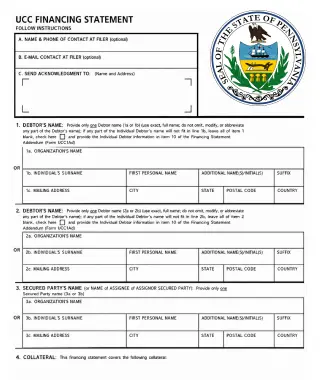
A UCC-1 financing statement is a public notice filed by a secured creditor to establish a security interest in specific collateral. It serves as a public notice establishing a lien, giving it priority over other creditors if the debtor defaults, and it is valid for 5 years.
What is a UCC-1 Financing Statement? A Pennsylvania UCC-1 financing statement is a legal document filed with the Pennsylvania Department of State to publicly establish a creditor's security interest in a debtor's personal property or business assets.
Why Does it Give Legal Notice Against Third Parties? A Pennsylvania UCC-1 financing statement gives legal notice to third parties by creating a public record of a secured interest in a debtor's assets and establishing priority over future creditors. Filed with the Pennsylvania Secretary of State, it legally "perfects" the interest, ensuring the creditor is "first in line" to claim the collateral if the debtor defaults.
What "Perfecting a Lien" Means and Why it Matters for Creditors: Perfecting a lien in Pennsylvania is the formal legal process of recording a security interest, by filing a UCC-1 form, mechanic's lien, or judgment with the state, to make it a public record and enforceable against third parties. It matters because it establishes priority, ensuring creditors are paid from asset sales before unperfected or unsecured creditors.
Where Most Pennsylvania UCC Filings Go: Most Pennsylvania UCC filings are submitted to the Pennsylvania Department of State, Bureau of Corporations and Charitable Organizations in Harrisburg.
The Exceptions: Filings related to real estate, such as timber, minerals, or fixtures, are typically made in the office where a mortgage on the real estate would be filed (e.g., county recorder of deeds).
What a PA UCC Search Reveals

A UCC filing in Pennsylvania search reveals active liens, security interests, and financial claims filed against a person or business's personal property, such as equipment, inventory, or accounts receivable. The details of a UCC search in Pennsylvania are as follows:
Debtor Name & Address - Provides the exact debtor's name, address, and status of the entity (active, merged, etc.) so you can determine if it is the correct debtor you are searching for.
Secured Party Name - Identifies lenders (secured parties) who have a legal claim on a debtor's assets so that you can contact them with further questions.
Collateral Description - Lists specific business assets (e.g., machinery, inventory, accounts receivable) pledged as security for loans. Sometimes the term "all assets" is used, which means that all current and future assets may be encumbered.
Filing Date - Shows the order of filings (by filing date), which determines which creditor has the first right to assets in a bankruptcy or default scenario.
Lapse Date - Reveals the lapse date when the filing will expire, typically 5 years from filing. If no continuation is filed within the valid window, the lien is dead.
Filing Number - A unique ID assigned by the state to differentiate the filing for retrieving certified copies or tracking amendments.
Amendments / Terminations - Shows if a UCC filing was continued, amended, assigned to another party, or terminated.
Assignees - Lists any other parties if the original secured party has transferred its interest to another entity.
Why Do UCC Filings Matter in Pennsylvania?

Pennsylvania is considered a high-volume state for Uniform Commercial Code filings, driven by its large, active business registry of over 3 million entities as of 2026.
The state's system processes a significant amount of data: Ninety-three percent of all UCC filings are submitted via electronic, bulk, or online methods, and 87,648 online filings were processed over the recent six-month period.
Filing a UCC-1 financing statement is the primary method to "perfect" a security interest, ensuring a lender has a superior claim to collateral, such as inventory, equipment, or accounts receivable, over other creditors. Since many out-of-state debtors borrow from Pennsylvania lenders, the state is a crucial jurisdiction to consider when conducting due diligence.
Additionally, some UCC-1s are filed with the state and others with county offices, making a state of Pennsylvania UCC search more complex. Real estate and co-op transactions further complicate the issue with fixture filings and co-op liens. Mergers and acquisitions due diligence in Pennsylvania often includes UCC searches to identify target companies and their secured creditors. That is why smooth, effective searches are necessary. EntityCheck aggregates data from both state and county resources, streamlining the search process.
How to Run a PA UCC Search

To run a UCC search in Pennsylvania, follow the detailed steps below:
Step 1: Identify the Correct Debtor Name
Pennsylvania UCC searches require strict name strings. If you don't enter the debtor's name correctly, even with a small variation like a missing middle initial, comma placement, or DBA abbreviation, your search could yield no results even when there are active filings. The Pennsylvania database does not support fuzzy matching, so you must enter the name exactly. Before attempting a search, use official documents such as the company's formation documents, or an individual's driver's license or passport to obtain their exact legal name. When searching for individuals, use the proper format (Last, First, Middle).
Step 2: Choose Your Search Method
You can search for UCC records in Pennsylvania in three ways: online with the state, by mail, and using a professional third-party search tool. Since Pennsylvania requires all filings to be submitted electronically, you can search by using the Pennsylvania Department of State Business Filings System online. Search for UCC filings by debtor name, secured party name, or exact filing number. For certified copies, you will need to fill out an electronic UCC-11 request form and pay $12. You can also request searches by mail by sending a completed UCC-11 form, along with $12-$15 per debtor name (depending on your requirements), to the Department of State, Bureau of Corporations and Charitable Organizations, PO Box 8722, Harrisburg, PA 17105-8722. You can also use an authorized search service that offers unlimited searches and the fastest turnaround time. EntityCheck combines state and county records, making searches quicker and easier.
Step 3: Review the Search Results
Receiving the results is only half of the equation. You must also review everything and verify it carefully. Review each active filing for the debtor's name and match it to other documents to ensure it is the correct debtor (not a coincidental match). Review the collateral description and match it to the encumbered assets. Look for any "all assets" language that indicates it covers all current assets and potentially future ones. Match the secured party identity to other official sources to ensure it is correct. Check the filing/lapse dates to see if the lien is still active. Review all amendments and continuations as these modify the original filing and may add to the collateral or extend lapse dates. Note if the lien has been terminated/released, and flag any assignments, meaning the original lien holder transferred the lien to another party.
Step 4: Obtain Certified Copies If Required
Although online records are adequate for internal due diligence, they are non-certified and cannot be used for any critical legal or business transactions that require proof. Certified copies of UCC filings carry the official Pennsylvania Department of State's seal, and they are required for court proceedings, real estate closings, and certain regulatory submissions. Lenders require certified copies to verify existing debt, check collateral priorities, and clear title issues. Buyers or investors use certified copies during due diligence to confirm a target company's outstanding liabilities. Pennsylvania courts and trustees require officially certified documents as undisputed evidence of a secured creditor's claim. Certified copies also serve as self-authenticating evidence in court. When registering your Pennsylvania business to operate in another state, the new state may require certified copies of your Pennsylvania filing history, which means certified copies. You can view records online the same day, but for certified copies, you must allow 1-3 days, so order them early. You must also pay a per-page fee for certified copies.
PA UCC Search for Out-of-State Businesses
Under the Uniform Commercial Code, the proper jurisdiction for searching a business's liens depends on where the company is legally organized. For most registered organizations in Pennsylvania, like corporations or LLCs, you must search the UCC records in the exact state where the business is formed, not necessarily where it does its physical work.
Even though you usually search in the company's home state, Pennsylvania's UCC records remain important for out-of-state debtors. If an out-of-state business registers to operate in Pennsylvania or owns physical assets, such as equipment or inventory, located in Pennsylvania, creditors can use Pennsylvania records to track down any local claims, secured loans, or tax liens attached to those assets.
To search these records, visit the official Pennsylvania Business Filing Services portal. You can look up active businesses, check for existing liens, and review filing histories by entering the debtor's exact legal name or entity number.
UCC Forms and Filing Duration in Pennsylvania

In Pennsylvania, Uniform Commercial Code forms are governed by Article 9 of the UCC and filed with the Pennsylvania Department of State, Bureau of Corporations and Charitable Organizations. Those used in Pennsylvania are as follows:
UCC-1 (Financing Statement): The UCC-1 is the most common form. It is filed to "perfect" a security interest, publicly establishing a lender's claim to specified collateral (such as equipment, inventory, or accounts receivable) if a debtor defaults on a loan or lease. UCC-1s remain valid for 5 years from the date of filing.
UCC-1AP (Amendment): This form serves as an attachment to the initial UCC-1 or UCC-3. If multiple debtors or secured parties are involved in a transaction, and their names and addresses cannot all fit in the designated boxes on the main form, the UCC1AP is used to list the additional parties.
UCC-3 (Amendment/Continuation): The UCC-3 is used to modify or update an already existing, active UCC-1 filing. A single UCC-3 form can accomplish one or more of the following actions: continuation, termination, assignment, or amendment.
UCC-5 (Information Statement): Formerly known as a correction statement, the UCC-5 is filed by a debtor who believes that a UCC-1 filed against them is inaccurate or was filed fraudulently. It allows the debtor to add a statement of record explaining why they contest the filing, though it does not invalidate the original filing.
UCC-11 (Information Request): The UCC-11 is used to search the state's public records. Lenders, businesses, or individuals submit this form to find any existing liens or active financing statements filed under a specific debtor's name.
How Long Are Pennsylvania UCC Filings Effective?
In Pennsylvania, Uniform Commercial Code financing statements are generally effective for exactly 5 years from the date they are filed. However, some situations change this lifespan clock.
Standard Lapse: When a lender files a UCC-1 statement to claim collateral for a loan, the claim is legally valid and publicly recorded for five years. After this exact date, the filing "lapses," and the lender loses their priority status. This means that if the borrower goes bankrupt or faces financial trouble, the lender risks becoming an unsecured creditor. The only way to continue it is to file a UCC-3 form within the 6-month window before it lapses.
Continuation: A continuation statement (a UCC-3 form) cannot just be filed at any time. Lenders must file it within the six-month window immediately before the five-year expiration date (not after, and not before). Filing this continuation extends the effectiveness of the original filing for another five years from the date the previous one was set to expire. There is no limit to how many times it can be extended, as long as the original debt remains outstanding.
Deceased Debtor: In Pennsylvania, a UCC filing remains effective for 5 years from the date of filing, even if the debtor dies. The debtor's death does not alter the duration of the filing, the secured status of the debt, or the need to renew the financing statement.
Manufactured Homes: Filings pertaining to these properties (manufactured homes and co-ops) may have different statutory timeframes under state law. For example, manufactured homes have a 30-year lapse date. If the filing relates to a public utility or a transmitting utility, the UCC statement remains effective until a termination statement is filed.
"All Assets" Lien: Pennsylvania UCC filings (financing statements) claiming "all assets" (a "blanket lien") are effective for 5 years from the date of filing. The "all assets" designation refers to the collateral affected, not the timeframe.
What Happens When a PA UCC Filing Lapses

When a UCC-1 lapses without a continuation filed in the valid window, the security interest becomes unperfected by law. The original secured party does not automatically retain its Pennsylvania rights; to re-perfect, they must file a brand-new UCC-1, which resets their priority clock to the new filing date. This has a direct impact on lien searches: a searcher who finds a filing with a past lapse date must check whether a continuation (UCC-3) was filed before that date. When reviewing search results, never assume a past-lapse-date filing is irrelevant without verifying that there is no continuation. Always verify everything.
UCC Lien Priority Explained
In Pennsylvania, UCC lien priority generally follows the "first to file, first in right" rule. This means the first creditor to properly file a UCC-1 financing statement with the Pennsylvania Department of State secures the highest claim to the debtor's collateral in the event of default or bankruptcy.
Complications arise when special exceptions override the basic rule. For example, creditors holding a Purchase Money Security Interest (PMSI) can jump ahead of earlier filers if they properly perfect their interest and notify other parties. Additionally, certain tax liens, agricultural liens, or possessory liens for repairs might take precedence over older security interests.
Because priority dictates who gets paid first, conducting a thorough UCC search is critical before extending credit. Lenders must search state records to verify existing claims, identify name discrepancies, and ensure no prior liens will prevent them from securing a top-priority position on the collateral. They must also check county records for fixture filings, co-op, and federal tax liens.
Who Needs a PA UCC Search
In Pennsylvania, you need to do a Uniform Commercial Code search if you are involved in a commercial transaction and need to verify if another party's assets are being used as collateral. Some of the most common use case scenarios are as follows:
Lenders and Financial Institutions

Pennsylvania banks and private lenders conduct searches before issuing loans to confirm whether a business already has debt or liens on its assets. Commercial banks, asset-based lenders, factoring companies, and equipment lenders use UCC searches to protect their interests before extending credit or supplying financing. The risk of not conducting a thorough UCC search is that after closing, you could find that the collateral securing the loan is already encumbered and promised to another lender, subordinating your position. That means if the borrower defaults, you may not be paid first or at all. Lenders must check all available resources for different types of liens, meaning you must check both state and county records to get a complete picture. EntityCheck makes this easy by automatically combining records from state and county offices. One search and you see everything you need.
Attorneys and Legal Professionals

Legal professionals conduct UCC searches on behalf of clients (typically during M&A deals, asset purchases, or bankruptcy proceedings) to ensure clear title to property and manage risk. Real estate attorneys are responsible for commercial deals and must check county records for any fixture filings before closing. Litigation attorneys use UCC searches to identify encumbrances on judgment debtors to see what is available to attach to, so their client gets paid. Failing to identify an undisclosed secured creditor or an encumbered asset during a pre-closing search could lead to post-closing issues or issues during bankruptcy or default. It can also affect creditor priority schedules, putting you lower down on the list than you should be. To save time and money, lawyers can use EntityCheck to search our robust platform and find all state and county filings in one place.
Businesses and Buyers

Entrepreneurs and investors conduct due diligence using UCC searches to uncover any hidden liabilities or secured claims attached to a company they are acquiring. That applies to someone buying a franchise or a regular business. The last thing you want is to purchase the business only to find that some of the assets/equipment are encumbered and you have inherited the lender's collateral claim. Wholesalers or equipment vendors perform searches before extending a line of credit or leasing expensive machinery to a business. Before suppliers extend trade credit, they run a UCC search to ensure another lender/supplier does not already cover the collateral. Agricultural liens can take priority over others. Some liens are recorded with the county, not state filings, so you won't see them if you search only the Pennsylvania Department of State Bureau of Corporations and Charitable Organizations. EntityCheck makes it easier for businesses and investors to search for liens by aggregating data from both state and county resources. A single EntityCheck search gives you the complete picture for due diligence.
Real Estate Professionals

Pennsylvania real estate professionals, co-op participants, and lenders on mixed-use properties use Uniform Commercial Code searches during property transactions to identify non-real estate liens (e.g., equipment or solar panels) attached to a property. Their goal is to ensure that a property transfers free and clear of hidden financial encumbrances. Professionals use UCC searches to uncover "fixture filings," which are security interests taken out on personal property permanently attached to a building. Common examples include commercial HVAC systems, built-in generators, and solar panels. For co-op buyers, a UCC search ensures that they do not inadvertently assume the previous owner's equipment debts and verifies that lenders have a clear title to the collateral they are financing. Because fixture filings generally do not appear in county deed or mortgage indexes, professionals must run a separate UCC search at the state level to get a complete picture of property liabilities. EntityCheck combines state and county filings, making the search process smoother and more efficient.
Individual Debtors and Business Owners

Before applying for a commercial loan, Pennsylvania business owners run UCC searches to check what assets are already encumbered. This helps them understand what collateral is available to offer new lenders. Business owners also regularly monitor UCC records to ensure no unauthorized UCC-1 financing statements have been fraudulently filed against their business. When acquiring another company or selling a business, stakeholders use a UCC search to assess the entity's financial health, existing debts, and obligations. Companies conduct searches on prospective clients or supply-chain partners to evaluate their financial stability and the risk of default. Since a lien from a paid-off loan can block new financing, staying on top of filings is crucial. EntityCheck offers a quick and easy way to check both county and state records simultaneously.
Pennsylvania-Specific UCC Considerations

In Pennsylvania, Uniform Commercial Code considerations generally refer to UCC filings for business/secured transactions (Article 9). The primary statewide considerations for UCC filings ensure compliance and reduce risk. For businesses and lenders, UCC filings are crucial for protecting financial interests and collateral. Pennsylvania follows the Revised Article 9 framework (enacted via the UCC Modernization Act), meaning most of the laws are standardized, though Pennsylvania applies specific operational practices such as:
Centralized vs. Local Filing
Under Pennsylvania's modernized code, almost all initial financing statements (UCC-1) and amendments (UCC-3) must be filed centrally with the Pennsylvania Department of State. The only exception is for "fixture filings" (collateral attached to real estate), which must still be filed with the local recorder of deeds at the county level.
Exact Debtor Names
Pennsylvania is incredibly strict about the names of debtors. The debtor's name on a UCC-1 must match the exact legal name on their organizational documents (like a driver's license or incorporation charter). Missing or adding a single letter, punctuation mark, or even the word "The" can render the entire financing statement invalid and unperfected. This applies to searching as well; a slight mistake will return no results, even when active filings exist.
Filing Fees and Requirements
Standard filing fees are $84.00 per form. Attachments are accepted, but if your filing requires them, it must be submitted on paper rather than through the state's Business Filing System website.
Duration and Renewals
UCC filings generally last for 5 years. A continuation statement (UCC-3) must be filed within the 6-month window prior to the 5-year expiration date to maintain priority over other creditors.
PA Co-Op Financing and UCC Filings
A co-op (or housing cooperative) is a unique way to own a home. Instead of buying the physical real estate, you are buying shares in a corporation that owns the entire building. Those shares give you the right to live in a specific unit. In Pennsylvania, co-ops are governed by the Real Estate Cooperative Act. Co-ops function much like condominiums, but they operate differently under the law in a few key ways. When you buy a Pennsylvania co-op instead of a deed, you receive a stock certificate proving that you own a certain number of shares in the corporation that owns the entire building. You also get a proprietary lease, a long-term agreement between you and the co-op corporation. This document gives you the legal right to live in your specific apartment. Because your home is a "share of stock" rather than "real estate," legally it is considered personal property (or movable property), not real estate. Because you do not own the actual real estate, you cannot get a standard mortgage loan. If you need to borrow money to buy your co-op shares, you will take out a "share loan". This is a public document. When you purchase your co-op, you and your lender sign this form, which legally states that your co-op shares serve as collateral for the loan. It acts just like a mortgage, "freezing" the shares so that you cannot sell them or take out another loan on them without paying off your debt first. The lender files this UCC-1 with the state, specifically with the Pennsylvania Department of State. This gives "public notice" to the world that the lender has a lien on your unit.
Agricultural Liens in Pennsylvania
Agricultural liens and UCC filings are legal tools that protect lenders and businesses when they provide money, goods, or services to farmers. They act as public safety nets, ensuring creditors can recover what they are owed if a farmer cannot pay their debts. When a farmer takes out a loan to buy a tractor, purchase seed, or cover operating costs, the bank requires them to sign a "security agreement." This agreement gives the bank the legal right to take specific assets if the loan is not paid. The bank then files a UCC-1 financing statement with the Pennsylvania Department of State. This puts other potential creditors on notice that the farmer's assets (like equipment, livestock, or crops) are already being used as collateral for a loan. If the farmer defaults, the creditor with the first-filed UCC-1 generally receives payment from the proceeds of the collateral sale. Unlike a UCC security interest, which you agree to voluntarily, an agricultural lien is created automatically by state law to protect the people who provide essential services or goods to a farm. If a farmer buys feed, fertilizer, or veterinary services on credit, the supplier is at risk of non-payment. To protect the supplier, state law automatically grants the supplier a "lien" on the farmer's crops or livestock to ensure payment. The farmer does not have to sign a specific agreement for this lien to take effect; it arises simply from the farmer's receipt of the goods.
Federal Tax Liens - A Separate Search Required
Both federal tax liens and UCC filings are public legal notices that establish a creditor's claim against an individual's or business's property. However, a UCC filing is a voluntary agreement used to secure business loans, while a federal tax lien is an involuntary, statutory claim resulting from unpaid taxes. Unlike a UCC filing, you do not sign a contract for a tax lien. It arises automatically by law the moment the IRS assesses a tax debt, sends a bill, and you fail to pay it within 10 days. A federal tax lien acts as an umbrella, attaching to all your current assets (real estate, vehicles, bank accounts) as well as any property or rights to property you acquire after the lien is filed. Federal tax liens are not part of the Pennsylvania Department of State Bureau of Corporations and Charitable Organizations; they are completely separate. To notify other creditors, the IRS will file a public "Notice of Federal Tax Lien." In Pennsylvania, this is filed with the Prothonotary's Office in the county where you own property, or with the Pennsylvania Department of Revenue for state-level tax debt. Searching only state records will not show federal tax liens. However, using EntityCheck, you can see federal tax liens and UCC filings from all state and county databases in one place, streamlining your search efforts.
Judgment Lien vs. UCC Lien
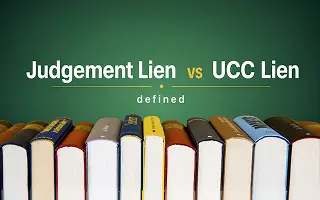
A judgment lien is an involuntary claim on real estate imposed by a court after a creditor wins a lawsuit. In Pennsylvania, it attaches directly to real estate rather than personal property. In contrast, a UCC lien is consensual and typically attaches to business or personal property (such as inventory or equipment).
To search for judgment liens in Pennsylvania, look up civil case records through the Unified Judicial System of Pennsylvania. Because judgment liens on real estate must be recorded at the county level, you should also check the Prothonotary's Office in the specific county where the debtor owns property.
In short, judgment liens target real estate via court orders, while UCC liens secure debts on personal and business property.
Pennsylvania UCC Search - Common Mistakes to Avoid
Conducting an accurate Uniform Commercial Code search in Pennsylvania requires careful, deliberate action to avoid overlooking active liens or misinterpreting public records. The most common mistakes include searching only exact legal names, ignoring past or trade names, and failing to verify that all attachments were properly indexed in the state's system.
Searching only the Pennsylvania Department of State database and missing county-level fixture filings - By searching only the Pennsylvania Department of State's website, you may miss crucial fixture filings or other liens like federal, mechanic's, and judgment liens filed at the county recorder's office. While the majority of UCCs are filed centrally with the Pennsylvania Department of State via PENN File, you must conduct a local county search if you are looking for fixture filings (liens attached to real estate) or specific agricultural liens.
Using an incorrect or abbreviated debtor name variation - Searching only the exact, current legal name of the entity is another mistake. Standard UCC search logic in Pennsylvania is an exact-match system, meaning even a missing comma or a slightly different corporate suffix can hide an active lien. Search variations of the name, including abbreviations (e.g., "Mfg." vs. "Manufacturing"), common misspellings, and previous legal names.
Assuming a filing past its lapse date is automatically extinguished - Assuming that just because a filing shows up on a report, it is an active, enforceable lien. Be sure to review the lapse dates and check whether you are searching for "All" records (including lapsed ones) or "Un-lapsed" (active) records only. UCC-1 filings typically expire after five years unless a continuation is filed.
Failing to search all debtor name variations - Failing to search for assumed, trade, or "doing business as" (DBA) names is another mistake. While filings should technically be under the legal entity name, creditors often mistakenly file under trade names, which you might miss if you only look up the parent entity. Check all known DBAs, fictitious names, and previous legal names (maiden names) the debtor has used in the past. For individuals, Article 9 of the UCC requires you to search using the name exactly as it appears on their current, unexpired state-issued driver's license or ID.
Not ordering certified copies when the transaction requires them - Not getting certified copies when you need them is another major issue. Non-certified online results are not accepted by the courts, at real estate closings, or in other business transactions. Not getting them on time can delay closings. Always order certified copies early, as they can take up to 3 days to arrive.
Treating a UCC search as a substitute for a federal tax lien search - Federal tax liens, agricultural, co-op, and fixture filings are recorded at the county level, not the state. You need to search both county and state records to get a complete picture and reveal all active liens.
Why Use EntityCheck for Your PA UCC Search
Pennsylvania is another very high-volume state for UCC filings, making it a crucial destination for searchers. Not only are most UCC filings recorded with the Pennsylvania Department of State Bureau of Corporations and Charitable Organizations, but fixture filings are recorded at the county level with county recorders, and, of course, federal liens are recorded at the federal level. All of this makes a UCC search in Pennsylvania complex, and if you don't search all available databases, you could miss critical liens that affect your company.
Manual searches take time and often money. To perform proper due diligence, you must thoroughly search all locations, which can be time-consuming, confusing, and yet still yield inaccurate results. EntityCheck offers a better, faster solution. Our search tool combines data from all state, county, and federal databases and allows unlimited searches. You get the right information at your fingertips when you need it, without the hassle of going through the Pennsylvania Department of State Bureau of Corporations and Charitable Organizations, multiple county websites, and related government agencies. Try a free search today.
FAQ
How long does a Pennsylvania UCC search take?
A Pennsylvania UCC search is instant when performed online. Records show an immediate filing acknowledgment. For official certified records, you can get results in 1 to 2 business days. Mailed or physical UCC-11 requests take longer, usually requiring about 1 to 2 weeks for processing.
How do I search UCC filings in Pennsylvania?
You can search UCC filings in Pennsylvania online through the state's official Business Filing Services (BFS) portal. Scroll to "Quick Navigation" and click Check a Status. From there, select UCC Filing to look up filings or UCC Information Request to pull up certified information. Alternatively, you can request searches via mail or in person. Standard searches submitted by mail cost $12 per debtor name. You may also use an authorized search agent, such as EntityCheck, to search both county and state records simultaneously.
How far back do PA UCC records go?
Pennsylvania UCC filings at the state level primarily date back to July 1, 2001, when the Uniform Commercial Code Modernization Act standardized and computerized the state's commercial database. Because UCC financing statements inherently lapse and expire if not legally continued, the online state registry only hosts currently active filings and those that have lapsed recently.
What is the difference between a state and a county UCC search?
The difference between a state and county Uniform Commercial Code search in Pennsylvania centers on where the lien is filed, which is determined by the type of collateral used to secure the loan. Searches for general business assets (e.g., inventory, accounts receivable, and equipment) records are filed centrally in Harrisburg. Records for "fixture filings" (collateral permanently attached to real estate, like HVAC systems or built-in equipment) are filed locally, at the county recorder of deeds' office where the real property is located.
How do I remove or terminate a UCC lien in Pennsylvania?
To remove or terminate a UCC lien in Pennsylvania, file a UCC-3 amendment marking the "Termination" box. The easiest way to do this is to have your lender submit it online; you can also legally terminate the debt yourself if it has been fully satisfied.
Are Pennsylvania UCC filings public record?
Yes, Pennsylvania Uniform Commercial Code filings are public records. They are used to notify the public that a creditor has a security interest in a debtor's assets. You can access these records online or by mail.
Do I need a UCC search for a Pennsylvania co-op apartment purchase?
Yes, you absolutely need a UCC search when buying a co-op apartment in Pennsylvania because you purchase shares of stock and a proprietary lease rather than traditional real property. Because co-op shares are considered personal property, any existing liens or loans are tracked under the Uniform Commercial Code rather than standard real estate land records. A UCC search will reveal if the current owner has pledged their co-op shares as collateral for a personal loan, equity line, or past debts.
What is a UCC-1 vs. a UCC-3 in Pennsylvania?
In Pennsylvania, a UCC-1 is the initial document filed to publicly establish a lender's lien on a business's assets, while a UCC-3 is a follow-up form used to alter, renew, or terminate that original filing. Both are filed with the Pennsylvania Department of State.
Can I search UCC filings by a secured party?
Yes, you can search Uniform Commercial Code filings in Pennsylvania by a secured party. You can conduct these searches using the Pennsylvania Business One-Stop Hub or through the Pennsylvania Department of State Uniform Commercial Code portal.
What counties in Pennsylvania require a separate UCC search?
In Pennsylvania, no specific county requires a separate standard UCC search for general business assets. Under Revised Article 9, Pennsylvania utilizes a centralized, "one-stop filing" system. All regular UCC-1 financing statements are filed and searched at the state level through the Pennsylvania Department of State, except for fixture filings, co-op liens, and those that secure timber, minerals, and as-extracted collateral.
How much does a PA UCC search cost?
A typical Uniform Commercial Code search through the Pennsylvania Department of State costs $12 per debtor name searched plus $3 per copied page. Certified copies cost an additional $28 per request.
Is a UCC search the same as a title search?
No, a UCC search in Pennsylvania is not the same as a title search. They serve completely different purposes, review different records, and cover entirely different types of assets under Pennsylvania law. A UCC search covers personal property and business assets (e.g., inventory, equipment, accounts receivable, and fixtures) used to secure a loan. A title search looks for real estate property (e.g., land, houses, and permanent structures).