Search Ohio UCC Filings & Liens

An Ohio state UCC search allows the public (both businesses and individuals) to check records from the Secretary of State's database for public liens or security interests filed against a debtor's personal property, such as equipment, inventory, or accounts receivable. It verifies if another party has a claim on these assets before lending money, purchasing a business, or entering into major financial transactions. Although most records are filed with the Secretary of State, certain UCC filings are recorded at the county level, making UCC searches more complex. Thankfully, EntityCheck solves the problem with a robust database that consolidates all UCC data in a single, easy-to-use platform and searches for variations with a single search string.
What Is a UCC-1 Financing Statement?
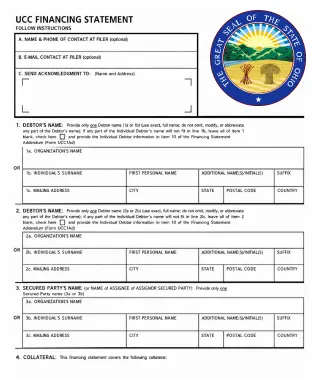
A UCC-1 financing statement in Ohio is a legal document filed by a creditor to formally declare a security interest in a debtor's personal property or assets, serving as public notice of a lien.
What is a UCC-1 Financing Statement? A UCC-1 financing statement (or UCC-1 form) is a public notice filed by a creditor to formally notify other lenders that they have a security interest in a debtor's personal property or business assets. It acts as a public notice that secures a lender's priority over collateral if the borrower defaults or files for bankruptcy.
Why Does it Give Legal Notice Against Third Parties? An Ohio UCC-1 financing statement acts as constructive public notice to third parties because it officially registers a creditor's security interest in a debtor's personal property with the Ohio Secretary of State. By filing this document, the secured party creates a public record that alerts potential creditors, lenders, and buyers that specific assets are already pledged as collateral and cannot be pledged again.
What "Perfecting a Lien" Means and Why it Matters for Creditors: Perfecting a lien in Ohio is the formal legal process of recording a security interest, often a mechanic's lien, with the county recorder to establish a legal claim against a debtor's property. It matters for creditors because, without strict compliance with filing deadlines and statutory requirements (ORC § 1311.01), a lien is void, leaving the creditor as an unsecured party who likely won't get paid
Where Most Ohio UCC Filings Go: Most Ohio UCC filings (UCC-1, UCC-3) are submitted directly to the Ohio Secretary of State, specifically through their online UCC Filing Portal for maximum efficiency. These filings, which secure interests in collateral, are processed at the state level, while real estate-related fixture filings are recorded with county recorders. The vast majority of financing statements are filed with the Ohio Secretary of State in Columbus, either online or by mail.
The Exceptions: UCC filings for as-extracted collateral, timber, or fixtures (e.g., HVAC systems in real estate) are recorded at the county recorder's office where the real estate is located.
What an OH UCC Search Reveals

A UCC search in Ohio reveals existing liens, security interests, and financial claims filed against a business or an individual's personal property, acting as a "title search" for assets. It identifies secured lenders, types of collateral (equipment, inventory), debtor/secured party details, and filing dates. The main eight data points are described below:
Debtor Name & Address - The debtor's legal name and address as listed on their driver's license or official business formation documents.
Secured Party Name - Identifies the party with a legal claim to the debtor's assets, which is critical for lenders and investors.
Collateral Description - Details what assets are pledged, such as equipment, inventory, or accounts receivable. Sometimes, "all assets" are listed, encumbering everything, or specific items are singled out.
Filing Date - The original UCC filing date, which establishes priority order when multiple creditors exist.
Lapse Date - A date, typically 5 years from the filing, after the lien will expire unless it is continued through a UCC-3.
Filing Number - The unique ID assigned by the Ohio Secretary of State for retrieving certified copies or tracking amendments.
Amendments / Terminations - Details on amendments, continuations, or assignments (e.g., amendment type, file number, and date)
Assignees - Shows whether the original secured party has transferred its interest to another party.
Why Do UCC Filings Matter in Ohio?

Ohio is a significant state for Uniform Commercial Code filings, operating a high-volume, centralized system that processed millions of dollars in fees in recent fiscal years. UCC filings in Ohio publicly establish a creditor's legal priority over a debtor's collateral, protecting the creditor in the event of default or bankruptcy.
Under Ohio Revised Code Chapters 1301–1310, these filings (typically UCC-1 forms) create a lien on business assets, notify other lenders of existing debt, and ensure "first to file" rights.
Ohio UCC filings use a highly centralized, digital-first system via the Secretary of State, which allows free online searches. Ohio differentiates filings by location, with most non-real estate filings processed through the SOS and with strict electronic validation of filing dates.
Because many filings are recorded with the state, but fixture filings and other liens (mechanic's/federal tax liens) are processed through the county, a UCC search in Ohio can be complicated. Real estate and co-op deals require an Ohio Secretary of State UCC search and certified copies to reveal existing liens before closing. That complexity extends to M&A due diligence, where Ohio businesses must investigate target companies to identify secured creditors before investing. A state of Ohio UCC search doesn't need to be complicated; use EntityCheck, which aggregates data from state and county databases to create a single search platform, making it quick and easy to find UCC liens.
How to Run an OH UCC Search

Performing a UCC filing in Ohio search is good due diligence. To conduct a thorough UCC search in Ohio, follow the steps below:
Step 1: Identify the Correct Debtor Name
Step one involves identifying the correct debtor's name. The Ohio Secretary of State UCC database does not use any fuzzy matching, so if you make a mistake (even a small one), forgetting a middle initial, a misplaced comma, or even a DBA abbreviation, the search can show zero results even when active filings exist. Be very careful to properly identify the debtor before running an Ohio Secretary of State business search for UCC records. When searching for individuals, always use the proper format (Last, First, Middle).
Step 2: Choose Your Search Method
When searching for Ohio UCC records, you have several methods at your disposal. You can search online using Ohio's UCC search tool, which is free for non-certified results. This method is fine for a preliminary review but not for an in-depth study. You can search by number (financing statement ID, reference number, or document ID), the debtor's name, city, and state, or by the secured party's name, city, and state. To request Uniform Commercial Code (UCC) filings by mail in Ohio, submit a UCC-11 Information Request form to the Ohio Secretary of State's office, along with the required fee of ($20.00). These must be mailed to the Columbus office. You can also use an authorized search service, which provides the fastest turnaround and handles state and county searches simultaneously.
Step 3: Review the Search Results
Step three involves carefully reviewing the search results. You must verify everything to ensure the data is what you expected and need. Check the debtor's name and confirm that it matches other documents. Be sure it's not just a coincidental match. Review the collateral description and match it to the debtor's assets. Watch out for "all assets" language, indicating that everything is covered. Check the secured party's identity and the filing/lapse data to verify that it is still active. Have any UCC-3s been filed to continue it? Check all amendments and continuations and look for any terminations. These UCC-3 filings can alter the original lien, expand collateral, or extend lapse dates. Some also transfer the lien from one party to another (assignments). These are crucial details you cannot overlook.
Step 4: Obtain Certified Copies If Required
Many UCC searches in Ohio for internal due diligence can be performed online and require no further action. However, high-risk legal and financial situations may require certified copies of UCC filings to verify a party's financial standing. Examples include closing commercial loans, conducting due diligence for mergers and acquisitions, or enforcing security interests. Certified copies are stamped with the official Ohio Secretary of State seal. When you order certified UCC results from the Ohio Secretary of State, they are generally processed within 1-2 days. However, it can take up to 3-5 days if the volume of requests is unusually high. The office does offer expedited services for a fee ($100). Each document/debtor name costs roughly $20. That fee covers the search; then you must pay an additional $2.00 per page plus a $1.00 certification fee.
OH UCC Search for Out-of-State Businesses
In Ohio, the jurisdiction rule for UCC filings is determined by the debtor's location, and requires that most business transactions be filed with the Ohio Secretary of State (not local counties). For registered organizations, this means filing in the state of incorporation, while for individuals, it is the state of residence. The UCC generally requires filing in the state where the debtor is organized (or resides), making Ohio the required venue for businesses incorporated there, even if creditors are based elsewhere.
Ohio is critical for out-of-state UCC filings because it serves as the jurisdiction of organization for many U.S. businesses, meaning that filings must be made with the Ohio Secretary of State to perfect security interests. Proper filings here are essential to establish creditor priority, protect interests in bankruptcy, and ensure compliance with state-specific Uniform Commercial Code rules, particularly for cross-state lending. The Ohio Secretary of State offers an online portal for filing UCC1, UCC3, and UCC5 forms, simplifying the process for out-of-state creditors, with legal framework and rules outlined in Chapter 111:1-3 of the Ohio Administrative Code.
Search for Ohio UCC records for an out-of-state business by using the Ohio Secretary of State's online UCC Filing Portal. This allows free searches by debtor name, secured party name, or file number to find active, lapsed, and image records. For comprehensive results, search the Secretary of State and sometimes county recorders for older filings. To make this process smoother, try using EntityCheck, a robust search portal that combines Secretary of State records with county filings.
UCC Forms and Filing Duration in Ohio

UCC filings in Ohio are generally effective for five years from the date of filing. The forms used in Ohio for UCC filings are as follows:
UCC-1 (Financing Statement): The initial filing form in Ohio that creates a security interest in collateral.
UCC-1Ad (Addendum): An addendum to the UCC-1 form providing additional space to add extra collateral or secured parties.
UCC-3 (Amendment/Continuation): Used to amend, assign, or continue existing filings. As a continuation, this form extends the effectiveness of a UCC1 for another five years. As an assignment, it transfers secured party rights. It can also be used to update the debtor's name, secured party details, or collateral descriptions.
UCC-3Ad (Termination): Filed upon repayment of the debt to release the security interest.
UCC-5 (Information Statement): Used to dispute or correct a filed record.
UCC-11 (Information Request): Used to search for existing filings.
How Long Are Ohio UCC Filings Effective?
Ohio UCC-1 financing statements are generally effective for five years from the date of filing. To maintain a perfected security interest, a continuation statement must be filed within the six-month window before the five-year expiration date. Special, longer, or indefinite terms apply to specific, rare filings, such as public-finance transactions (30 years) or those involving transmitting utilities. Depending on the situation, effective filing durations may change as described below:
Standard Lapse: The standard duration of a UCC filing in Ohio is five years from the filing date. A lien with no continuation filed before the lapse date is extinguished and will be rendered ineffective.
Continuation: A UCC-3 continuation statement can be filed only within 6 months of the 5-year expiration. Once filed, it will extend the filing for another five years, effectively resetting the lapse date. There is no limit to how many times the creditor can extend the date (as long as the debt remains unpaid).
Deceased Debtor: In Ohio, UCC-1 financing statements generally remain effective for five years from the date of filing, even if the debtor dies. The debtor's death does not automatically shorten the UCC filing period. However, secured creditors must still present claims against the estate within 6 months of the debtor's death to enforce their security interests.
Manufactured Homes: Manufactured-home transactions and public-finance transactions are effective for 30 years.
"All Assets" Lien: Ohio UCC-1 financing statements, including those covering "all assets" (i.e., all business assets), are generally effective for 5 years from the date of filing. The "all assets" designation does not extend or shorten the lapse date; it applies only to the number of assets encumbered.
What Happens When an Ohio UCC Filing Lapses

When an Ohio UCC filing lapses without a continuation filed during the valid window (per Section 1309.515 of the Ohio Revised Code), the secured party immediately loses their perfected status and priority position over other creditors. The security interest becomes unperfected, and the filer cannot revive it with a late continuation statement; they must start over and file a new UCC-1, losing their original spot in line. The new UCC filing resets their priority clock to the new filing date, and other filings can leapfrog ahead of them. According to the Ohio Admin. Code 111:1-3-30, the Ohio Secretary of State keeps the lapsed record in the index for at least one year after the lapse date before potentially removing it. Lapsed or terminated filings often remain in searches, allowing other lenders to see that a prior security interest once existed. This becomes critical for searchers who, when they see a lapsed date in the past, must check whether a continuation was filed before it actually lapsed. Always double-check the results and never assume a past lapse date means the lien is dead. Check for new UCC-1s and UCC-3s that continue the filing.
UCC Lien Priority Explained
In Ohio, UCC lien priority is generally determined by the "first-to-file-or-perfect" rule, established under Ohio Revised Code Section 1309.322. The first creditor to file a UCC-1 financing statement with the Ohio Secretary of State, or to perfect their security interest (usually through filing), gains top priority on the collateral, regardless of when the loan was made or when the security interest attached. Proper filing provides public notice and acts as a "first in time, first in right" system.
Complications arise from several key exceptions to this general rule that can disrupt the priority chain. Specifically, a Purchase Money Security Interest (PMSI) in non-inventory collateral (like equipment) can take precedence over an earlier-filed blanket lien if perfected within 20 days of the debtor taking possession. Other risks include prior-filed, but incorrectly indexed, liens, possessory liens that take precedence by law, or "future advances" clauses that allow a senior lender to secure additional loans with higher priority than intervening lenders.
This first-to-file rule makes a thorough UCC search, often conducted via the Secretary of State, critical for evaluating risk before closing a deal. Because a secured creditor's position depends on knowing what has already been filed, a search allows a new lender to confirm the availability of collateral, assess the risk of competing security interests, and negotiate appropriately to avoid being behind a prior-filed blanket lien.
Who Needs an OH UCC Search
An Ohio UCC search is essential for lenders, businesses, prospective buyers, and legal professionals to identify existing liens on a debtor's business assets. It verifies whether equipment, inventory, or accounts receivable are pledged as collateral, enabling risk assessment and creditor priority determination before finalizing loans, acquisitions, or financing transactions.
Lenders and Financial Institutions

Asset-based lenders, commercial banks, factoring companies, and equipment lenders all use UCC searches to check for existing liens (priorities) before issuing new loans, ensuring they know their position in the event of a debtor default. These institutions risk advancing credit against collateral that is already encumbered, so a search is crucial to protect their interests. EntityCheck allows lenders to perform a single search to view liens from UCC filings and county records (judgment, mechanics, and federal liens) in a single, easy-to-use platform, providing instant results.
Attorneys and Legal Professionals

Attorneys (M&A, bankruptcy, real estate, and litigation) use UCC searches to protect their clients against loss. They require certified copies as evidence in court to prove a creditor's security interest in property. Before acquiring property or a business, these professionals use UCC searches to reveal secured creditors before closing to avoid any post-closing liabilities, especially in a later bankruptcy. Ensuring their client is at the top of the priority list is crucial. Thankfully, EntityCheck makes this easier for legal professionals by allowing them to search a single database for both state and county filings.
Businesses and Buyers

Companies that purchase business assets need UCC searches to protect their investment. Franchise and regular business buyers must also check for any existing liens/encumbrances on assets before buying. Businesses that extend trade credit also need to know that a customer has assets available that are not already encumbered. Buyers or investors use certified records to identify all liabilities and secured debts of a target company. That last thing a company needs is to inherit a debtor's collateral claims on inventory, equipment, or accounts receivable. Since many filings are with the state, but fixture filings, federal liens, and others are recorded at the county level, you need to dig deeper and perform a more comprehensive search using an authorized search agent that combines state and county records in one place.
Real Estate Professionals

Commercial real estate professionals strive to protect their clients as best as they can. Before a commercial real estate closing, attorneys or agents must conduct thorough due diligence to identify any potential roadblocks to a successful closing. Co-op buyers, lenders on mixed-use properties, and others involved in real estate also need UCC searches in Ohio to uncover liens and encumbered assets. A title search will not reveal UCC filings, and checking only state records may miss crucial fixture filings or federal tax liens. When personal property, such as HVAC systems or equipment, is attached to real estate, certified records are required from the county recorder (for fixtures) or the Secretary of State for all other assets. The best way to search all records at once is to use an authorized search service like EntityCheck that aggregates data from multiple databases, streamlining the search process.
Individual Debtors and Business Owners

Even after a loan is paid off, the lien is often not released. Business owners and borrowers use UCC searches to check their own status to ensure that a terminated lien has actually been released. Lenders may check to ensure they correctly filed a continuation of an existing lien. An undetermined lien from a paid-off loan can block new financing and halt the purchase of property. It can also complicate the sale of property. For the fastest and easiest method of searching UCC filings, use EntityCheck, a robust search platform offering much more than just UCC filings.
Ohio-Specific UCC Considerations

Ohio UCC rules are primarily codified in Title 13 (Chapters 1301-1310) of the Ohio Revised Code, which generally adopts the Uniform Commercial Code. Ohio-specific considerations include state-specific electronic filing requirements, a 5-year duration for financing statements, distinct filing locations for real estate vs. general business assets, and specific 6-year/4-year statutes of limitations for contract actions.
Ohio UCC Filing and Recording Procedures
Most UCC financing statements (UCC-1) and amendments are filed with the Ohio Secretary of State, mostly electronically via XML. Only filings involving real property-related collateral, such as fixture filings, timber to be cut, or as-extracted collateral, are filed with the local county recorder's office.
UCC filings in Ohio are generally effective for five years from the date of filing. To maintain perfected status, continuation statements must be filed within six months before the 5-year expiration date.
Ohio search logic follows strict criteria for identifying debtor names, including distinctions between individuals and organizations, as outlined in 0.5.12.
Specific Ohio Article Considerations
Article 2 - Sales (R.C. 1302): Governs the sale of goods. Ohio recognizes specific "F.O.B." terms and rules regarding the risk of loss, particularly 0.5.13.
Article 9 - Secured Transactions (R.C. 1309): Governs security interests in personal property.
Transmitting Utilities: Filings against a "transmitting utility" are handled differently and remain in the searchable index for at least one year after termination.
Ohio requires electronic filing for UCC claims. If electronic filing is not possible, the Secretary of State may allow alternative methods (e.g., paper) under specific circumstances.
Legal and Contracts
Under R.C. 1302.04 and 1335.05, contracts for the sale of goods over ($500) must be in writing to be enforceable.
The statute of limitations for written contracts is six years after the cause of action accrues. For oral contracts, it is 4 years from the accrual of the cause of action.
While the UCC governs the sale of goods, Ohio courts rely on common law for contracts regarding services or real estate.
OH Co-Op Financing and UCC Filings
In Ohio, co-op apartments are not real property; they are shares in a cooperative corporation paired with a proprietary lease. Therefore, no deed exists for the lender to encumber when the borrower takes out a mortgage. Instead, the lender takes out a security interest in the co-op shares and proprietary lease. Lenders financing cooperative (co-op) units in Ohio almost always require a UCC-1 search and filing to verify lien priority. Because co-op shares are considered personal property rather than real estate, a UCC-1 financing statement must be filed with the Ohio Secretary of State to secure the lender's interest. Before buying a co-op, a purchaser must always perform thorough due diligence, which includes a search of state records (SOS) and county recorder's offices.
Agricultural Liens in Ohio
Agricultural liens in Ohio are statutory, automatic legal claims designed to protect sellers of farm products and providers of agricultural services, ensuring they receive payment. These liens, such as the Agricultural product lien (ORS 1311.55) or those for feeding/boarding animals (ORS 1311.48), attach to products, livestock, or proceeds without needing the debtor's consent. They typically cover contract prices or the current fair market value. Liens, such as those for agricultural producers delivering to handlers, attach automatically upon delivery of the product. Statutory liens on agricultural commodity handlers (like grain elevators) take priority over all other competing lien claims. Agricultural liens in Ohio, specifically producers' or handlers' liens on agricultural products, are perfected by filing an affidavit with the county recorder in the county where the agricultural product was delivered to the handler. These liens are filed to protect producers from non-payment by grain handlers or other buyers.
Federal Tax Liens - A Separate Search Required
Federal tax liens in Ohio are enforced by the IRS and act as a legal claim against a taxpayer's property, including real estate and personal assets, following failure to pay tax debt. The IRS files a Notice of Federal Tax Lien with the local Ohio county recorder, attaching it to all current and after-acquired property, which complicates the sale or refinancing of assets. This presents a problem for UCC filing searchers who may only check state records, thereby missing current federal tax liens. Whenever there is money on the line, always perform a complete lien search across state and county databases, which EntityCheck automatically combines, making searching quick and easy.
Judgment Lien vs. UCC Lien
An Ohio judgment lien is a non-consensual encumbrance placed on a debtor's real estate following a court-ordered judgment (e.g., in the Court of Common Pleas) to secure payment for a debt. It differs significantly from a UCC lien, which is a consensual security interest usually placed on personal property or business assets (such as inventory or equipment) and filed through the Ohio Secretary of State. While a UCC lien secures a loan or credit agreement, a judgment lien exists specifically to enforce a court ruling, after a lawsuit.
To search for Ohio judgment liens, you must generally check the records of the Court of Common Pleas in each county where the debtor owns real estate, as certified judgments are filed at the county level. In contrast, UCC liens are recorded at the state level. However, a comprehensive search often requires checking both the Ohio Secretary of State's online database of UCC filings and the local county recorder's records for judgments, taxes, and mechanics' liens.
Searching both the county common pleas records for judgment liens and the Secretary of State for UCC filings is essential for complete due diligence, as a judgment lien attaches to land. In contrast, a UCC lien secures personal property assets.
Ohio UCC Search - Common Mistakes to Avoid

When conducting an Ohio UCC search, you must be very careful to avoid some common mistakes that could skew your results. The primary pitfalls involve using incorrect search criteria, neglecting to search all relevant parties, and failing to understand Ohio's specific search methodologies.
*Searching only the Ohio DOS state database and missing county-level fixture filings - Fixture filings (collateral attached to real property, such as HVAC systems) are filed at the county level, not with the Secretary of State. Failing to search the county recorder records for these is a common mistake, and you may miss critical filings.
*Using an incorrect or abbreviated debtor name variation - Searching only for "Inc." when the entity is "Corp.", or ignoring punctuation (e.g., searching "AB&C" instead of "A B & C") can miss crucial filings. In Ohio, filing a DBA name is not recognized as a formal business registration. A search must use the entity's exact legal name as it appears on its most recent formation documents. Appending a debtor's name with a "Doing Business As" (DBA) in the search field can be messy, as this makes the search "seriously misleading", and it may not return the correct results.
Assuming a filing past its lapse date is automatically extinguished - Failing to check if a UCC-1 financing statement has been continued, as a UCC-3 continuation can extend the lien for another five years, making it still active. Additionally, terminated filings appear on search reports, and misinterpreting these can lead to thinking a lien is active when it is not, or vice versa.
Failing to search all debtor name variations - Failing to search under previous legal names, maiden names, common misspellings, or variations for individuals (e.g., using "Bob" instead of "Robert") can also cause you to miss active filings.
Not ordering certified copies when the transaction requires them - Keep in mind that non-certified online results are not accepted for court filings or real estate closings; substituting them can delay closings. You must order your certified copies well in advance to receive them.
Treating a UCC search as a substitute for a federal tax lien search - Standard UCC searches do not show federal tax liens, pending litigation, or judgment liens. A comprehensive search must include these, along with searching the Secretary of State's records for trade names and the UCC database.
Why Use EntityCheck for Your OH UCC Search
Ohio is another high-volume state for UCC filings, making it a crucial destination for searchers. Not only are most UCC filings recorded with the Ohio Secretary of State, but fixture filings are recorded at the county level with county recorders, and, of course, federal liens are recorded at the federal level. All of this makes a UCC search in Ohio complex, and if you don't search all available databases, you could miss critical liens that affect your company.
Manual searches take time and often money. To perform proper due diligence, you must thoroughly search all locations, which can be time-consuming, confusing, and yet still yield inaccurate results. EntityCheck offers a better, faster solution. Our search tool combines data from all state, county, and federal databases and allows unlimited searches. You get the right information at your fingertips when you need it, without the hassle of going through the Ohio Secretary of State, multiple county websites, and related government agencies. Try a free search today.
FAQ
How long does an Ohio UCC search take?
An Ohio UCC search typically takes 1 to 3 business days for mail-in requests, though online, self-service searches provide immediate results. Online searches on the Ohio Secretary of State's portal are free and instant, while manual "offline" searches by submitting a form cost $20 and may take several days.
How do I search UCC filings in Ohio?
To search UCC filings in Ohio, use the free online search tool on Ohio Business Central, managed by the Ohio Secretary of State. You can search by debtor name, secured party name, or financing statement number to view, download, and print UCC1, UCC3, and UCC5 records.
How far back do OH UCC records go?
Ohio UCC records for active filings generally go back to at least July 2001, which is when Revised Article 9 mandated central filing with the Secretary of State. Before July 1, 2001, many UCC documents were recorded locally at the county level. According to Rule 111:1-3-30 of the Ohio Administrative Code, a financing statement must remain in the searchable index until at least one year after it lapses.
What is the difference between a state and a county UCC search?
The primary difference between a state and a county UCC search in Ohio lies in the type of collateral being secured and the filing timeframe. A state-level search, conducted through the Ohio Secretary of State, covers most modern, secured transactions (filed after July 2001), while a county-level search is necessary for real estate-related collateral (fixtures), pre-2001 filings, or specific local liens.
How do I remove or terminate a UCC lien in Ohio?
To remove a UCC lien in Ohio, the secured party (lender) must file a UCC-3 Termination Statement with the Ohio Secretary of State after a debt is paid, generally within 20 days of an authenticated demand. If the lender fails to act, you can file the termination yourself, provided you have proof that the debt is paid off.
Are Ohio UCC filings public record?
Yes, Ohio UCC filings are public records, and the state provides a searchable record of secured loans and liens. These records allow businesses and individuals to check for existing liens against a debtor's assets (collateral). You can search for these filings online for free through the Ohio Secretary of State via debtor name or file number.
Do I need a UCC search for an Ohio co-op apartment purchase?
Yes, a Uniform Commercial Code search is highly recommended and pretty much a standard practice when purchasing a co-op apartment in Ohio to ensure the shares and lease are free of liens. Because co-ops are personal property (shares) rather than real estate, you must check for liens against the seller's shares.
What is a UCC-1 vs. a UCC-3 in Ohio?
A UCC-1 in Ohio is the initial financing statement that establishes a lender's legal claim (lien) on a debtor's business assets. A UCC-3 is the subsequent amendment or statement used to update, renew, or terminate the existing UCC-1.
Can I search UCC filings by a secured party?
Yes, you can search UCC filings by a secured party in Ohio for free using the Ohio Secretary of State's Online UCC Filing Portal. The system allows you to search by secured party name (individual or organization) or by debtor name and file number to identify active liens and collateral interests.
What counties in Ohio require a separate UCC search?
In Ohio, while most UCC financing statements are filed centrally with the Secretary of State, a separate search may be required at the county recorder's office for specific types of collateral, particularly fixture filings (items attached to real estate), timber, minerals, or as-extracted collateral, as these items are filed there.
How much does an OH UCC search cost?
A standard Ohio Uniform Commercial Code search typically costs $20.00 per request and covers searching by a specific debtor's name. While fees for official reports at the county level are $20, online searches of images and filings can often be done for free via the Ohio Secretary of State's online portal. Certified copies also cost $20 plus $2 per document.
Is a UCC search the same as a title search?
No, a UCC search in Ohio is not the same as a title search. A UCC search covers liens on personal property or business assets (like equipment or inventory), whereas a title search covers ownership and liens on real property (land and buildings). They are complementary, not identical. When conducting thorough due diligence, you need to do both.