Search Michigan UCC Filings & Liens

A Michigan state UCC search uncovers public records of liens and security interests placed against a business or individual's assets. It reveals whether other lenders already have a legal claim on the debtor's property, inventory, or equipment to secure a loan. Although most UCC filings are recorded and managed by the Michigan Department of State's Uniform Commercial Code Division, fixture filings, timber to be cut, and as-extracted collateral must still be recorded locally with the county's Register of Deeds where the real estate is located, making Michigan UCC searches complex and cumbersome. EntityCheck solves the problem with an easy-to-use database that consolidates all lien filings, including UCC data, in a single, user-friendly platform and searches for variations with a single search string.
What Is a UCC-1 Financing Statement?
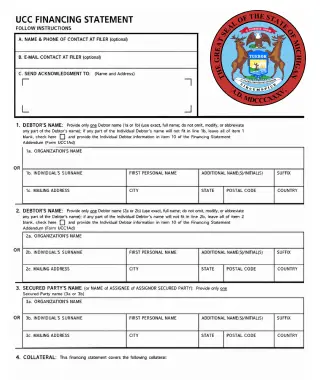
A Michigan UCC-1 financing statement is a formal document filed with the state to publicly assert a creditor's security interest in a borrower's personal property. It gives official public notice that a lender has a claim on specific collateral or business assets to secure a loan.
What is a UCC-1 Financing Statement? A UCC-1 financing statement is, in effect, a public notice that functions like a recorded deed, but for a business's personal property rather than real estate. It creates a transparent public record that warns other potential lenders or buyers that the debtor's assets are already encumbered.
Why Does it Give Legal Notice Against Third Parties? It cements the creditor's place in line. Under the Uniform Commercial Code, the "first to file" generally has priority over the collateral if the borrower defaults or goes bankrupt. It gives legal notice to third parties and protects the creditor in several critical ways. It puts other potential creditors on notice that the assets are already being used as collateral. Under the "first to file or perfect" rule, the earliest UCC-1 filing gets first dibs on the collateral if the borrower defaults. Without public notice, a subsequent lender might unknowingly extend a loan using the same assets as collateral. By checking the public registry, third-party lenders can determine whether the asset is already encumbered.
What "Perfecting a Lien" Means and Why it Matters for Creditors: Perfecting a lien is the legal process creditors use to make a security interest valid and enforceable against third parties. It usually involves filing official documents (like a UCC-1 financing statement) or taking possession of the collateral. It matters most often in the context of a default or bankruptcy. If a debtor files for bankruptcy, the court issues an automatic stay that halts most collection efforts. However, a properly perfected lienholder is treated as a "secured creditor" rather than an "unsecured creditor". This means your claim is backed by the collateral, shielding you from losing the debt in a bankruptcy discharge.
Where Most Michigan UCC Filings Go: In Michigan, nearly all Uniform Commercial Code financing statements are filed centrally with the Michigan Secretary of State's Uniform Commercial Code Division. Filings and transactions must be completed electronically via the Michigan UCC Online Customer Portal.
The Exceptions: Certain filings are not made with the state and must instead be filed locally with the county register of deeds office where the real estate is located. Examples include financing statements filed as a fixture filing for goods that are or are to become attached to real property, or filings for timber to be cut, minerals, or the like (such as oil and gas) that are subject to a security interest and are extracted, which get filed with the county.
What an MI UCC Search Reveals

A Michigan UCC search reveals public notices that a creditor or lender holds a legal claim or security interest in a debtor's business or personal property (often as collateral for a loan). The details of the data are as follows:
Debtor Name & Address - The legal name and address of the individual or business entity borrowing the money or using the asset as collateral.
Secured Party Name - The name and contact information of the financial institution or creditor holding the claim.
Collateral Description - A written outline of the specific assets pledged for the loan (e.g., inventory, equipment, accounts receivable, or a specific fixture).
Filing Date - The exact date the financing statement was submitted to the state and its tracking number. The filing date establishes priority among multiple creditors.
Lapse Date - The date the filing lapses, which is typically 5 years from filing, after which an unfiled continuation means the lien is extinguished.
Filing Number - A unique ID assigned by the Michigan Department of State for retrieving certified copies or tracking amendments.
Amendments / Terminations - Shows whether the filing has been modified, extended, or released using UCC-3 forms.
Assignees - Lists any assignees and whether the original secured party has transferred their interest to another entity.
Why Do UCC Filings Matter in Michigan?

Michigan handles a moderate but consistent volume of UCC filings, heavily driven by its active manufacturing, automotive, and commercial industries. Uniform Commercial Code filings matter in Michigan because they publicly record a lender's legal claim on a business's personal property (collateral). Governed by the Michigan Compiled Laws (Act 174), they protect lenders, establish debt priority, and ensure transparency in commercial transactions.
Filing UCC-1s in Michigan protects creditors by perfecting their security interests, establishes priority for who gets paid first, and prevents fraud by preventing dishonest borrowers from using the same collateral to secure loans from multiple unsuspecting lenders. Michigan-based lenders file UCC-1s against borrowers across the county, making Michigan a critical search jurisdiction even for out-of-state debtors.
Although most UCC filings are recorded with the Michigan Department of State, Bureau of Customer Services (UCC Division), some, such as fixture filings, as-extracted collateral, timber, and real estate attached property filings, are recorded with the county register of deeds. That means for thorough due diligence, you must search both county and state records.
Real estate and co-op transactions in Michigan use UCC searches to uncover liens, fixture filings, and co-op share financing before a deal can close. M&A due diligence also uses UCC searches to investigate target companies and identify secured creditors before purchasing.
How to Run a MI UCC Search

To run a Michigan Uniform Commercial Code search, you can use the state's online portal, submit an official request form by mail, or use an authorized search service for a streamlined approach. Follow the detailed steps below when running a UCC filing in Michigan search.
Step 1: Identify the Correct Debtor Name
Michigan uses very strict naming rules for UCC filings. That means you must enter the exact legal, correct name to find active filings. The system does not use fuzzy matching, and even a small error, such as a comma placement, a missing middle initial, or a DBA abbreviation, can return zero results when there are active filings. For businesses, use the company's formation documents, not a Certificate of Good Standing, to find the actual legal name. For individuals, use the legal name on their passport or driver's license. When searching for individuals, be sure to enter the name in the proper format (Last, First, Middle).
Step 2: Choose Your Search Method
When searching, you have a few options. You can find non-certified results through the Michigan Department of State, Bureau of Customer Services (UCC Division) portal. You must create an account to use the system. Then select Individual or Organization to begin your search. Enter the exact name of the business or person. These non-certified results are suitable for a preliminary review, but you must purchase certified copies for any official transactions and pay a fee per debtor name. You can also request search results by mail by filling out a UCC-11 and mailing it to the Michigan Department of State, Uniform Commercial Code Section, PO Box 30197, Lansing, MI 48909-7697. When filling out the form, be sure to select either Search Certificate & Copies or Face Copies. To search more efficiently and receive instant results, use an authorized search service that allows you to search both state and county resources simultaneously.
Step 3: Review the Search Results
Once you complete your search, review the results carefully. Check everything over for accuracy, starting with the debtor's name. Match it to the person you are searching for and ensure it's not a coincidental match. Verify the collateral description and match it to the encumbered assets that you know about. Check for "all assets" language, meaning all equipment and inventory are attached (past and present). Review the secured party's identity and the filing/lapse dates to confirm that it is still active. Look for amendments, terminations, and continuations (UCC-3s) as these modify the original filing and may increase the collateral, add new parties, or extend the lapse date. Note any assignments where the original filer transferred the lien to another entity.
Step 4: Obtain Certified Copies If Required
When performing a UCC search in Michigan, non-certified results from the state's online portal are sufficient for internal due diligence, preliminary lender review, and basic research, but for any official transaction that involves legal matters or money, you need certified copies. Certified copies of UCC filings have the state seal and are accepted by the courts, real estate closings, and certain regulatory submissions. Whenever you need actual, physical proof of a UCC filing or lien, you can get it as a certified hard copy. Order them early, as they take 1-3 business days, and you must pay a fee per debtor name.
MI UCC Search for Out-of-State Businesses
In Michigan, the Uniform Commercial Code (UCC) Jurisdiction Rule governed by UCC Article 9 (codified under MCL 440.9301 et seq.) determines which state's laws govern the perfection and priority of security interests in collateral. It generally dictates that the law of the jurisdiction where the debtor is located governs these matters. A "registered organization" (e.g., corporations, LLCs, limited partnerships) is located in the state where it is organized or chartered. For example, an LLC formed in Michigan is governed by Michigan UCC law, regardless of where its physical headquarters are. Unregistered entities or individuals are located in their state of principal residence. If a debtor relocates to Michigan, a previously perfected security interest remains perfected in Michigan for 4 months, after which the creditor must perfect it under Michigan law to maintain priority.
Michigan matters significantly for out-of-state debtors and UCC filings because the state strictly enforces the location-based filing requirements of UCC Article 9. Additionally, Michigan serves as a crucial defensive jurisdiction against predatory out-of-state collection tactics because it lacks local authority to enforce predatory Confessions of Judgment (COJs).
To search for UCC filings against out-of-state debtors in Michigan, you generally need to check the jurisdiction where the debtor is legally organized or resides. Under Revised Article 9 of the UCC, the laws of the debtor's home state govern perfection, meaning most filings will be found there rather than in Michigan.
UCC Forms and Filing Duration in Michigan

UCC Forms Used in Michigan
Uniform Commercial Code forms are legal documents that creditors file to declare a security interest in a borrower's assets publicly. In Michigan, these forms are primarily governed by Article 9 of the Uniform Commercial Code (MCL 440.9101 et seq.) and are processed through the Michigan Department of State's online customer portal.
UCC-1 (Financing Statement): The UCC-1 form establishes a lien and perfects a creditor's security interest in personal or business property. It serves as official public notice that a specific lender has a stake in collateral (e.g., inventory, equipment, accounts receivable), securing their "place in line" to claim those assets if the debtor defaults.
UCC-3 (Amendment/Continuation): The UCC-3 form is a multi-purpose document used to update or alter an existing UCC-1. A single UCC-3 form is used for multiple actions, including continuations, amendments, assignments, and terminations.
UCC-7 (Fraudulent UCC Financing Statement Affidavit): Specific to Michigan, individuals who have had a fraudulent or unauthorized UCC financing statement filed against them can use this affidavit. It allows the named debtor to formally contest fraudulent claims without needing a court order, prompting the state to investigate and remove the unauthorized record.
UCC-11 (Information Request): The UCC-11 form is used to request copies of filed documents or conduct an official search of the state's UCC records. Creditors, legal professionals, and businesses use this during due diligence to determine whether a debtor has existing liens or competing claims against their assets. This can be filed through the Michigan Department of State's UCC Online Portal, which allows users to search by debtor name or lien/filing number.
How Long Are Michigan UCC Filings Effective?
In Michigan, UCC filing duration is dictated by the Michigan Legislature Section 440.9515 and depends entirely on the type of transaction, as detailed below:
Standard Lapse: Effective for 5 years from the date of filing. A lien with no continuation filed before the lapse date is extinguished.
Continuation: The secured party must file a UCC-3 continuation form within the 6-month window before the lapse date to extend the effectiveness by another 5 years. Outside this window, a continuation is ineffective. There is no limit to the number of continuations they can file.
Deceased Debtor: The death of a debtor does not shorten or alter the effective period of a Michigan UCC financing statement; it remains in effect for its standard 5-year term. The death also does not immediately destroy the security interest or require an amendment to the filing.
Manufactured Homes: Effective for 30 years from the date of filing, provided the statement explicitly indicates it is connected to a manufactured-home transaction.
Public-Utility or Transmitting Utility Transactions: Effective until a termination statement is filed, meaning they do not expire on a standard 5-year cycle.
"All Assets" Lien: A Michigan UCC "all assets" blanket lien is effective for 5 years from the initial filing date. Expanding the scope of the collateral to all assets does not extend the baseline duration.
What Happens When a MI UCC Filing Lapses

When a UCC-1 lapses without a continuation filed in the valid window, the security interest becomes unperfected by state law. The original secured party does not automatically retain its Michigan rights. To re-perfect, they must file a brand-new UCC-1, which resets their priority clock to the new filing date. This has a direct impact on lien searches: a searcher who finds a filing with a past lapse date must check whether a continuation was filed before that date. When reviewing search results, never assume a past-lapse-date filing is irrelevant without verifying the absence of a continuation.
UCC Lien Priority Explained
The basic rule for UCC lien priority in Michigan is "first to file or perfect". This means that the first creditor to file a UCC-1 financing statement with the state formally, or to perfect their security interest, typically secures the first position. If the borrower defaults, the first-position creditor is paid from the sale of the secured collateral.
However, a few complications can shake up the priority. For instance, a lender that provides funds specifically to buy a specific piece of equipment or inventory can obtain a "super-priority" called a Purchase Money Security Interest (PMSI). Additionally, non-consensual claims like tax or judgment liens might sneak in, and perfection can happen through asset possession rather than filing, making those claims invisible on standard public records.
This priority system drives the search decision because new lenders must know exactly where they stand in line. If an existing "blanket lien" claims all of a business's current and future assets, a new lender will likely demand a subordination agreement or refuse to fund the loan altogether to protect themselves from being stuck behind another creditor.
Who Needs a MI UCC Search
A UCC search in Michigan is primarily used to identify existing liens, loans, or security interests placed on a business or an individual's personal property or assets. Professionals conducting these searches usually perform due diligence by obtaining online or certified copies. Some of the most common professionals using this service are as follows:
Lenders and Financial Institutions

Asset-based lenders, commercial banks, factoring companies, and even equipment lenders use UCC searches to evaluate a borrower's available collateral and to check for any competing creditors before approving commercial, equipment, or small-business loans. Investors and venture capitalists use them to assess the financial health and debt obligations of a startup or established company seeking capital investment. These lenders use UCC searches to assess risk and avoid extending credit or advancing funds against collateral already encumbered by someone else. Doing so would subordinate their position and risk them not getting paid at all. For full-pictured due diligence, these professionals can use EntityCheck to search both state and county databases simultaneously.
Attorneys and Legal Professionals

M&A, bankruptcy, and real estate attorneys use UCC searches during mergers, acquisitions, and restructurings to identify hidden debts, verify asset ownership, and advise clients on the risks of entering into business transactions. M&A advisors and brokers use UCC searches as part of the due diligence process when buying or selling a business to ensure the assets being acquired are free of encumbrances. Failing to identify a secured creditor during a pre-closing search creates a post-closing liability and can even affect the deal or delay closings. That is why it is imperative to check both state and county databases using EntityCheck to ensure thoroughness and avoid missing any active liens.
Businesses and Buyers

Companies buying assets from other businesses use UCC searches to ensure the equipment is not already encumbered by a lender. An asset purchase without a UCC search could mean you assume the seller's encumbrances. Franchise and business buyers also need to fully review the target company's assets (equipment, inventory, receivables) to ensure none are subject to active liens. Although UCC filings are handled by the state in Michigan, fixture filings and agricultural filings are held at the county level. To conduct thorough due diligence before buying a business or equipment, you must check both places to find all active liens. EntityCheck makes this easy by combining data from state and county databases into a single search.
Real Estate Professionals

Commercial real estate attorneys who handle closings use UCC searches in Michigan to identify fixtures or equipment in a commercial building that may be subject to a creditor's lien. These professionals protect their clients by identifying liens and encumbered assets before they become issues. Co-op participants need to check for UCC and fixture filing liens, so they don't inherit someone else's debt or buy an apartment that is already encumbered. Mixed-use property lenders must protect themselves by conducting a UCC search and checking for UCC and fixture filings. A title search will not reveal UCC and other types of liens on the property. To cover all your bases, use EntityCheck, where one search reveals liens and filings from both the state and Michigan counties.
Individual Debtors and Business Owners

Michigan business owners use Uniform Commercial Code searches primarily to assess financial risk, verify collateral availability, and secure their own lending positions. These public records indicate whether another creditor has already claimed a business's assets as collateral. They also check their own records and standing to ensure that paid-off loans have been formally released. This does not always happen automatically. Before taking out loans or seeking credit, individuals and business owners check their UCC records to ensure a clean slate, since an outstanding lien from a paid-off loan can block new financing or complicate a sale. EntityCheck offers the quickest turnaround for fast searches of both state and county databases.
Michigan-Specific UCC Considerations

Michigan's Uniform Commercial Code governs commercial transactions and business contracts. Michigan UCC laws are based on the national model; however, Michigan incorporates specific rules regarding filing locations, name requirements, and agricultural/mining interests to fit local business operations.
Statewide Filing (Centralized)
Unlike some states that split UCC filings between state and county levels, Michigan requires almost all UCC-1 financing statements to be filed centrally with the Michigan Department of State. Filings can be managed electronically or by mail.
Strict Name Rules
The debtor's name on a financing statement must match their official documentation exactly. For registered organizations, the name must match the exact name on your Articles of Organization (filed with LARA). For individuals, it must match the unexpired Michigan driver's license.
Agricultural Protections
Michigan has strict sub-rules protecting agricultural liens. A lender supplying goods or services, or leasing real property to a farmer, may hold an agricultural lien that is prioritized even without taking possession of the property.
As-Extracted Collateral
Michigan has a specific framework for "as-extracted collateral," which includes oil, gas, or minerals before extraction, as well as accounts generated at the wellhead or minehead. Security interests in these resources require distinct filing procedures.
Effective Duration
A standard UCC filing in Michigan is valid for 5 years from the date of filing. Lenders must file a continuation statement within the 6-month period before the expiration date to maintain their place in line.
MI Co-Op Financing and UCC Filings
When you buy a co-op apartment in Michigan, you do not actually buy the real estate; you buy shares in a corporation and receive a proprietary lease. Co-op financing differs from traditional real estate mortgages because lenders use these shares as collateral, securing the loan by filing a UCC-1 statement. In a standard home purchase, the bank puts a mortgage directly on the physical property through the deed. In a co-op, the corporation owns the whole building. Because shares are considered "personal property" (not real estate), lenders cannot issue a traditional mortgage. Instead, you receive a share loan. This contract gives the lender the right to take your co-op shares and lease if you stop making your loan payments. It involves a three-way contract between you, the lender, and the co-op board. It legally binds the co-op board to notify your lender if you fall behind on maintenance fees and prevents you from selling or changing your shares without the lender's permission. Because the bank is lending you money using personal property (shares) as collateral rather than real estate, they do not record a standard mortgage at your county's register of deeds. Instead, the lender files a UCC-1 Financing Statement with the state (typically the Michigan Secretary of State). This is a public notice to other creditors: "We have a lien on this person's co-op shares". It establishes the lender's place in line so that another bank cannot claim your shares if you go into debt. If you fail to make your share loan payments, the lender does not need to go through the lengthy judicial foreclosure process required for a traditional home. Instead, under the UCC, they can hold a non-judicial auction to sell your shares and proprietary lease to a new buyer to recoup their money.
Agricultural Liens in Michigan
Agricultural liens and UCC filings in Michigan are both legal tools that protect creditors by placing a "hold" on farm assets (such as crops, livestock, or equipment) to ensure payment. They both involve filing a public notice, called a UCC-1 Financing Statement, with the state, but they operate in very different ways. Agricultural liens in Michigan don't require the farmer's signature or voluntary agreement. They are automatically created by Michigan state law to protect businesses that provide essential goods and services to farmers on credit. If you provide seed, fertilizer, fuel, or livestock feed to a farmer and they don't pay you, state law allows you to place a lien on those crops or the proceeds from their sale. To make the lien valid and secure your place in line to get paid, you must file a UCC-1 Financing Statement with the Michigan Secretary of State and formally notify the debtor within 10 days. Because a farmer might have multiple loans and unpaid supplier bills, Michigan follows the "first to file, first in right" rule. Whoever records their UCC-1 statement first generally is first in line on the collateral if the farmer defaults or goes bankrupt.
Federal Tax Liens - A Separate Search Required
Federal tax liens in Michigan follow the standard IRS collection process but use localized, state-specific rules for filing and enforcement. A federal tax lien is the government's legal claim against your property due to unpaid taxes. It attaches to all of your current and future assets (real estate, vehicles, bank accounts) and to business property (such as accounts receivable). The lien is automatically created when the IRS assesses the tax and issues a bill that you fail to pay. To establish priority over other creditors, the IRS files a Notice of Federal Tax Lien in the office of the register of deeds in the specific Michigan county where your property is located. For personal property, the IRS files the notice with the Michigan Secretary of State (or locally, depending on the taxpayer's residence). Federal tax liens have nothing to do with UCC filings, and you will not find them when performing a UCC search in Michigan. You must search county records to find federal tax liens, mechanic's, agricultural, and judgment liens. To get the most complete picture, use EntityCheck, which combines all state and county databases to see all liens.
Judgment Lien vs. UCC Lien
A UCC lien is a voluntary agreement used by lenders to secure business assets or personal property. In contrast, a Michigan judgment lien is an involuntary claim imposed by a court that attaches strictly to a debtor's real estate to satisfy a civil money judgment, like when a credit card company sues an individual for unpaid charges.
To search for Michigan judgment liens, you need to check at the county level. Because judgment liens are tied to real property, they are recorded with the register of deeds in the specific county where the debtor owns land. You should also verify underlying court records through the Michigan Courts Case Search or the appropriate local county circuit court.
Understanding where to look is crucial because UCC liens are filed with the state, while judgment liens require county-level and court research to uncover. EntityCheck combines both state and county records for a more efficient search process.
Michigan UCC Search - Common Mistakes to Avoid

Conducting a UCC search in Michigan requires strict adherence to state-specific rules. Common and costly mistakes include searching only exact legal names, ignoring DBAs or trade names, failing to check variations in spelling or punctuation, and searching the wrong jurisdiction or office.
Searching only the Michigan Department of State database and missing county-level fixture filings - Many UCC filings get recorded with the county offices. Therefore, if you only search the state database, you will miss crucial liens that need to be factored in.
Using an incorrect or abbreviated debtor name variation - Searching only for the exact corporate name (e.g., "Great Lakes Manufacturing, Inc".). The state's search logic is specific. Missed filings can occur due to slight abbreviations (e.g., "Mfg." instead of "Manufacturing"), ampersands instead of the word "and," or extra spaces. Search multiple variations of the debtor's name and check for previous legal names.
Assuming a filing past its lapse date is automatically extinguished - Looking only at active UCC-1 financing statements. A previously lapsed filing might contain critical information about the collateral, or there may be UCC-3 amendments, continuations, or assignments that completely alter the scope of the lien. Ensure your search parameters cover un-lapsed statements, lapsed statements (up to one year after lapse), and all associated amendments.
Failing to search all debtor name variations - Assuming liens are only filed under the official corporate or individual name. Debtors often conduct business and secure assets under assumed names or "doing business as" (DBA) titles. A blanket lien filed under an old trade name can still attach to assets you think are "clean". Ask the debtor for any and all aliases, past corporate names, or operating names they have used, and search those thoroughly.
Not ordering certified copies when the transaction requires them - Non-certified online results are not accepted by court filings, real estate deals, and other official proceedings. Always order certified copies well in advance. It can take 1-3 business days. If you try to use non-certified online results for court filings or real estate closings, they may be rejected and create delays.
Treating a UCC search as a substitute for a federal tax lien search - Federal tax liens are a completely different type of lien and not included in any UCC filing database. To perform a complete search, you must search both county and state resources.
Why Use EntityCheck for Your MI UCC Search
Michigan is another very high-volume state for UCC filings, making it a crucial destination for searchers. Not only are most UCC filings recorded with the Michigan Department of State's Uniform Commercial Code Division, but fixture filings are recorded at the county level with county recorders, and, of course, federal liens are recorded at the federal level. All of this makes a UCC search in Michigan complex, and if you don't search all available databases, you could miss critical liens that affect your company.
Manual searches take time and often money. To perform proper due diligence, you must thoroughly search all locations, which can be time-consuming and confusing, yet still yield inaccurate results. EntityCheck offers a better, faster solution. Our search tool combines data from all state, county, and federal databases and allows unlimited searches. You get the right information at your fingertips when you need it, without the hassle of going through the Michigan Department of State's Uniform Commercial Code Division, multiple county websites, and related government agencies. Try a free search today.
FAQ
How long does a Michigan UCC search take?
A UCC search in Michigan is instant. You can conduct free preliminary searches for active business liens and financial statements online via the Michigan UCC Customer Portal or EntityCheck, using a debtor name or filing number. Official certified search requests can be submitted via the Michigan UCC Customer Portal. Processing time for these certificates is typically 1-3 business days.
How do I search UCC filings in Michigan?
You can search Michigan Uniform Commercial Code filings online or by submitting an official request form by mail. Use EntityCheck or the Michigan UCC Customer Portal for instant, non-certified results.
How far back do MI UCC records go?
Michigan Uniform Commercial Code records date back to January 1, 1964, when Act 174 of 1962 (the state's original UCC legislation) officially took effect. While the official electronic database maintained by the Michigan Secretary of State allows you to search active and recent filings online, records of historical, lapsed, or purged filings typically only remain visible for limited periods (usually 5 to 6 years) unless continuation statements were continually filed.
What is the difference between a state and a county UCC search?
The main difference is that a Michigan state UCC search covers broad, statewide business assets, while a county UCC search is strictly limited to "fixture filings" (items attached to real estate) and specific agricultural liens.
How do I remove or terminate a UCC lien in Michigan?
To remove or terminate a UCC lien, you must file a UCC-3 Financing Amendment with the state to indicate that the debt has been fully satisfied. Request your lender (secured party) to submit the UCC-3 form. By Michigan law, if there are no outstanding obligations, the lender must provide or file a termination statement within 20 days of receiving a written, authenticated demand. Some lenders charge a standard filing fee of ($25) to ($100). If your lender ignores your 20-day written demand or refuses to file the termination statement, you can legally file it yourself.
Are Michigan UCC filings public record?
Yes, Michigan UCC filings are public records. Anyone can access them to check for security interests, liens, or collateral agreements attached to individuals or businesses. The Michigan Department of State's Uniform Commercial Code Division records and manages UCC filings, but you can also find them using an authorized search service like EntityCheck, which aggregates data from both state and county databases.
Do I need a UCC search for a Michigan co-op apartment purchase?
Yes, you generally do need a Uniform Commercial Code lien search when purchasing a cooperative apartment in Michigan. In a co-op, you are technically purchasing shares of stock or a membership certificate in the housing corporation and receiving a proprietary lease, rather than buying traditional "real estate". Because these shares are considered personal property, any existing loans or debts against the unit are secured through the UCC, and the property is not recorded via a traditional deed or mortgage.
What is a UCC-1 vs. a UCC-3 in Michigan?
A UCC-1 is the initial financing statement a lender files to publicly claim rights to a borrower's business assets as collateral. A UCC-3 is an amendment form used to change, renew, or terminate the existing UCC-1 filing.
Can I search UCC filings by a secured party?
Yes, you can search for UCC filings by a secured party in Michigan. You can conduct a public search online through the Michigan UCC Customer Portal. The state's system allows you to search with specific parameters, including the secured party's name, to verify existing liens, check collateral, or conduct due diligence.
What counties in Michigan require a separate UCC search?
In Michigan, no counties require a separate UCC search. Michigan operates a centralized UCC filing system, meaning all standard personal property UCC filings and searches are handled at the state level by the Michigan Department of State (UCC Division). Because UCC filings are unified statewide, there are no separate databases for specific cities or areas, such as Detroit or Grand Rapids. However, you do need to search at the county-level if you are dealing with specific real estate-tied collateral.
How much does an MI UCC search cost?
A standard Uniform Commercial Code search in Michigan costs ($6.00) per debtor name for a regular search request. Additional fees may apply depending on your specific needs. Expedited service costs an additional ($25.00) per debtor name. You must also pay $2.00 per page for copies of any effective records found. If you require an impression of the official Secretary of State seal on the search certificate, you must pay an additional $6.00.
Is a UCC search the same as a title search?
No, a UCC search and a title search are not the same; they serve different purposes and check entirely different sets of records. A UCC search checks the Michigan Department of State's Uniform Commercial Code Division for financing statements. It reveals if a business has pledged its personal property or assets (such as equipment, inventory, or accounts receivable) as collateral for a loan. A title search checks property deeds, mortgages, and tax records at the county register of deeds office for the county where the real estate is located. It is used to verify the actual ownership and legal history of a specific piece of real estate (land and permanent buildings). You need a title search to ensure no one else owns your land, and a UCC search to ensure no one else has a claim to the furniture, machinery, or business assets inside it.