Search Illinois UCC Filings & Liens

UCC filings in Illinois are legal documents that creditors file to publicly announce their legal security interest in a debtor's personal property or business assets. They secure loans by establishing priority in case of default, allowing lenders to seize collateral. Filings must be accurate to be valid. UCC filings in Illinois are unique due to strict formatting requirements, including mandatory all-capital letters, 12-point Times New Roman font, and a centralized electronic filing system managed by the Secretary of State. To cut through the noise when searching UCC records, you can use EntityCheck, a robust database that consolidates all UCC data in one easy-to-use platform, making a UCC search in Illinois faster and easier.
What Is a UCC-1 Financing Statement?
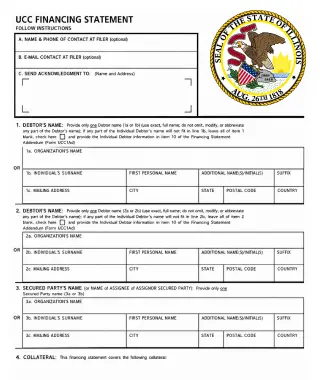
A UCC financing statement is a public notice filed by a secured creditor to establish a legal claim over specific collateral. It secures loans by allowing creditors to establish priority over assets, such as inventory or equipment, should the debtor default on the loan. The notice is a legal document recorded and maintained by the Illinois Secretary of State.
What is a UCC-1 Financing Statement? A UCC-1 financing statement in Illinois is a legal form filed by lenders with the Illinois Secretary of State to provide public notice of a security interest in a debtor's personal property (collateral).
Why Does it Give Legal Notice Against Third Parties? A UCC-1 financing statement provides legal notice against third parties by creating a public record of a creditor's security interest in a debtor's collateral; it perfects the security interest, establishing priority over other creditors in bankruptcy and preventing the debtor from using the same assets for other loans.
What "Perfecting a Lien" Means and Why it Matters for Creditors: Perfecting a lien in Illinois is the legal process of recording a security interest, such as a mechanic's lien or UCC filing, with the appropriate authority to make it enforceable against third parties. It matters to creditors because it establishes priority over other creditors, ensures the right to foreclose on collateral, and protects against the debtor's bankruptcy.
Where Most Illinois UCC Filings Go: Most Illinois UCC filings are submitted to the Illinois Secretary of State, Department of Business Services, via its online portal, which offers 24/7 access. For in-person or mail submissions, documents go to their office in Springfield, IL.
The Exceptions: If the collateral consists of goods that are or will become fixtures (e.g., HVAC systems, machinery installed in a building), the filing must be submitted to the county recorder's office where the real estate is located. Filings for timber to be cut or minerals/oil/gas that are to be extracted must be filed in the county records office. If the debtor is not in Illinois, the filing must be made in the state where the debtor resides, or their business was organized.
What an IL UCC Search Reveals

An Illinois state UCC search reveals eight main data points as detailed below:
Debtor Name & Address - Legal names and addresses of individuals or organizations that have pledged assets as collateral.
Secured Party Name - The secured party (lender, creditor, bank, etc.) that filed the lien and holds the claim.
Collateral Description - A summary or description of the specific assets (e.g., equipment, inventory) or blanket liens ("all assets") used as collateral.
Filing Date - The original filing date (which establishes priority order), document number, and whether a filing is active, terminated, or continued.
Lapse Date - The date the lien will expire, typically 5 years from filing, after which an unfiled continuation means the lien is dead.
Filing Number - A unique ID assigned by the Illinois Secretary of State for the purpose of retrieving certified copies or tracking amendments.
Amendments / Terminations - UCC-3 amendments show whether the filing has been modified, extended, or released. These are subsequent filings that modify, assign, or terminate the initial lien, allowing you to see if a loan was repaid or the lien was released.
Assignees - If the lien was transferred to another party, the data will show details of any assignees.
Why Do UCC Filings Matter in Illinois?

UCC filings matter in Illinois for legally securing business loans, establishing creditor priority in bankruptcy, and providing public notice of liens on assets. They protect lenders from losing collateral to competing creditors and alert prospective lenders to existing debts, serving as a critical risk-management tool under Illinois law.
A properly filed UCC-1 financing statement with the Illinois Secretary of State establishes a lender's priority over other creditors in the event of a borrower's default or bankruptcy. In Illinois, "first to file" usually wins. These filings allow creditors (lenders) to secure a lien on a debtor's personal property or fixtures (e.g., equipment, inventory, furniture), enabling them to recover the value of the assets if the borrower stops making payments.
UCC filings create a public record that lenders and buyers use to check for existing liens on a business's assets. Unresolved or blanket liens can make it difficult for businesses to obtain new loans. If a debtor fails to make payments, the lender with the first filed, accurate UCC filing holds the top position in the queue to receive proceeds from the sale of the assets.
UCC filings matter largely in real estate and M&A deals. During due diligence, attorneys, real estate professionals, analysts, and others check UCC records by conducting an Illinois Secretary of State UCC search to identify all liens against property or portions of property (fixture filings) before investing or purchasing equipment.
How to Run an IL UCC Search

Follow the steps below to efficiently perform an Illinois Secretary of State business search for UCC records.
Step 1: Identify the Correct Debtor Name
Illinois has very strict rules about UCC filings and name designations. Therefore, when you search, you must identify the exact name, as the database does not support fuzzy matching. Search for the debtor's name exactly as it appears on their driver's license or official business formation documents (found in public records). Perform multiple searches and check for name variations to ensure a comprehensive search. If you don't enter the exact name correctly, with even a single variation (missing middle initial, comma placement, or DBA abbreviation), you can miss crucial results. When searching for individuals, be sure to follow the proper format (Last, First, Middle).
Step 2: Choose Your Search Method
When searching for a UCC-1 financing statement and related documents, you have three main options. You can use the Illinois Secretary of State's online UCC search portal to find non-certified results. You may search by the debtor's personal name, debtor's business name, debtor's business name word, or file number. You can also mail in a UCC-11 form to request certified records. Information can be requested by mail through the Illinois Secretary of State Department of Business Services in Springfield or the Chicago location. This method takes longer and requires a fee. A more efficient approach is to use an authorized search service for fast, easy access to UCC records in Illinois and across the U.S., combining state and county records in a single search, streamlining your efforts.
Step 3: Review the Search Results
After receiving the search results, you must continue the process by verifying the information. To be thorough, you must review each active filing for the debtor's name and confirm that it matches the correct debtor that other documents show. Match the collateral description to the actual assets encumbered and to whether "all assets" language is present. Verify the secured party identity (you can check other public records to confirm) and the filing/lapse dates to confirm that the lien is still active. Be sure to check UCC-3 filings for any amendments, terminations, or changes to the lien. Note any Illinois assignments where the lien has been transferred away from the original party to a new lien holder.
Step 4: Obtain Certified Copies If Required
In many cases, you can rely on unofficial, viewable records, for example, when performing internal due diligence or basic research. However, in Illinois, you may need to obtain certified copies of UCC filings for formal legal, financial, or foreign qualification purposes where official verification of a security interest is necessary. These are typically needed during business loan or closure proceedings, for evidence in legal proceedings, or when registering Illinois business entities in other states. You can get same-day non-certified results when searching online. When ordering certified copies by mail, you may have to wait several days to a few weeks and pay the required fee. Fees vary and change frequently.
IL UCC Search for Out-of-State Businesses
Like many states, Illinois follows the jurisdiction rule for UCC filings, adhering to Article 9, which requires the creditor to file in the debtor's state of incorporation or organization for most personal property collateral. For Illinois-incorporated businesses, UCC financing statements must be filed with the Illinois Secretary of State's central filing office.
Illinois UCC-1 filings are critical for out-of-state debtors because Illinois law governs the perfection of security interests if the debtor is incorporated or organized in Illinois. Proper UCC filing rules by state require that a lender file with the Illinois Secretary of State to preserve lender priority, especially in bankruptcy. This ensures that creditors' liens are valid and enforceable, preventing them from being subordinate to other creditors.
To perform an Illinois Uniform Commercial Code search for an out-of-state (foreign) business, search the Illinois Secretary of State's database for active liens filed against the company's assets located within Illinois. First, identify the correct debtor's name, perform an online search, and then order certified copies using a UCC-11 form. Be sure also to check local county records for fixture filings (fixtures, minerals, timber).
UCC Forms and Filing Duration in Illinois

Below are the forms that Illinois uses for UCC filings, changes, terminations, assignments, and document requests.
UCC-1 (Financing Statement): The UCC-1 financing statement is the initial document filed to perfect a security interest, establish a legal claim or lien on a debtor's collateral, and establish priority over other creditors.
UCC-1Ad (Addendum): This form is used alongside the UCC-1 when additional space is required to list additional debtors or secured parties, provide a longer collateral description, or if the filing is a fixture filing (collateral attached to real estate).
UCC-1Ap - A supplemental form used when there are more than two debtors or secured parties to list on an initial UCC-1 filing.
UCC-3 (Amendment/Continuation): The UCC-3 amendment is a multifunctional form used to change, continue, or terminate an existing, active UCC-1 filing.
UCC-3Ad (Amendment Addendum): Similar to the UCC-1Ad, this is used to provide additional information, such as extra party names or collateral descriptions, when filing a UCC-3 amendment.
UCC-3Ap - Used to list additional parties when amending a filing that involves multiple debtors or secured parties.
UCC-5 (Information Statement) - This is a statement filed when a person believes that a record filed with the Secretary of State is inaccurate or was wrongfully filed. It does not affect the effectiveness of the initial UCC-1 but serves as a public record of the dispute.
UCC-11 (Information Request): This form is used to request a search of the UCC database for existing filings against a specific debtor. It is used to confirm lien status during due diligence to identify existing liens.
UCC-58 (Payment Cover Sheet) - An internal Illinois Secretary of State form used to submit payments for filings, often for setting up an account for electronic filing rather than paying by credit card directly with the filing.
How Long Are Illinois UCC Filings Effective?
Illinois UCC filings are effective according to the lien status and other criteria. Use the list below to determine how long an Illinois UCC filing is effective.
Standard Lapse: In Illinois, UCC-1 financing statements are generally effective for five years from the date of filing. To maintain priority, secured parties must file a continuation statement within 6 months of the 5-year expiration date.
Continuation: Continuation statements can only be filed within the final six months of the five-year period. A continuation resets the clock and provides the UCC filing, five more years of active status.
Deceased Debtor: Illinois UCC filings remain effective for their original five-year term even if the debtor dies, as the death does not shorten the perfection period. Creditors must still file a continuation statement within 6 months of the 5-year expiration to maintain priority. The security interest continues to cover the collateral held by the decedent's estate.
Manufactured Homes: In Illinois, UCC-1 financing statements filed specifically in connection with manufactured-home transactions are effective for 30 years from the date of filing. This long-term effectiveness applies provided the appropriate "Manufactured-Home Transaction" box is checked on the UCC1Ad form, preventing the filing from defaulting to the standard five-year duration.
"All Assets" Lien: In Illinois, UCC-1 financing statements, including "all assets" (blanket) liens, are generally effective for five years from the date of filing. These filings automatically lapse if a continuation statement is not filed within six months before the five-year expiration date. The "all assets" designation applies to the assets included, not the timeframe.
What Happens When an IL UCC Filing Lapses

When an Illinois UCC-1 financing statement lapses because a continuation was not filed within the valid six-month window, the secured party's interest becomes unperfected as a matter of law, rendering the claim invalid against other creditors. The original secured party does not automatically retain its original priority rights and must file a new UCC-1 to re-perfect, which unfortunately resets its priority clock to the new filing date. Consequently, this has a major impact on lien searches: a searcher who identifies a filing with a past lapse date must immediately verify whether a valid continuation was nevertheless filed before the deadline. Ultimately, never assume a past-lapse-date filing is completely irrelevant, as confirming the absolute absence of a valid continuation is crucial for proper lien analysis.
UCC Lien Priority Explained
In Illinois, UCC lien priority generally follows the "first-to-file-or-perfect" rule under Article 9. This means that the creditor who files a UCC-1 financing statement first with the Illinois Secretary of State secures the senior position, regardless of when the loan was actually made. A properly perfected, earlier-filed security interest takes precedence over later filings, ensuring the first creditor is paid first from the collateral proceeds in the event of a default or bankruptcy.
Several exceptions can alter this order, most notably the Purchase Money Security Interest (PMSI). A PMSI, such as financing for specific new equipment, can jump ahead of a prior "blanket lien" if perfected within 20 days of the debtor's receipt of the goods. Furthermore, non-UCC encumbrances, such as federal tax liens or judgment liens filed in different locations, can take priority over a later-filed UCC interest, requiring a thorough, comprehensive search.
Because of these complexities, a thorough UCC search in Illinois is critical to identify all potential superior claims before closing a loan. Lenders must confirm their priority position by searching for exact debtor names, including potential name variations, to avoid being stuck behind existing secured creditors. Skipping this due diligence or misfiling can result in a complete loss of recovery, rendering the entire risk management process ineffective.
Who Needs an IL UCC Search
Anyone extending credit, purchasing business assets, or financing equipment in Illinois should perform a UCC lien search to identify existing secured interests in a debtor's assets. Some key participants include lenders, investors, buyers, and legal professionals.
Lenders and Financial Institutions

Banks, financial institutions, factoring companies, equipment lenders, and asset-based private lenders must conduct UCC searches in Illinois to confirm priority and ensure the collateral is not already pledged. If creditors fail to take this step, they may not be paid first from the proceeds of an equipment sale if the borrower defaults on the loan. Lenders operate on tight closing schedules, and performing deep research can take time, especially when searching multiple state and county databases. To make this process easier, EntityCheck combines data from state and county offices all across the U.S., making UCC searches effortless.
Attorneys and Legal Professionals

Attorneys and legal professionals (such as M&A attorneys, bankruptcy attorneys, real estate attorneys, attorneys representing parties in mergers, acquisitions, or commercial loans, and litigation attorneys) in Illinois perform UCC lien searches to perform mandatory due diligence, ensuring their client's security interest has priority over other creditors, identifying existing liens on assets, and mitigating risks before closing business transactions or loans. Since UCC-1 filings reveal encumbrances on a debtor's personal property, failing to perform a pre-closing search can result in post-closing liability or, even worse, during bankruptcy, the creditor may fall below others in the priority schedule. These professionals' time is money; therefore, they must rely on authorized, accurate search results to save time and find the details they need.
Businesses and Buyers

Buyers performing due diligence on equipment or business assets must thoroughly check all UCC filings to ensure they are not buying encumbered property. Before purchasing a franchise or an existing business, you must conduct due diligence, or you could close on the deal only to find that your equipment is worth nothing because it has existing liens. The last thing you want to do is to inherit someone else's collateral claims. Some business owners use UCC searches to review their own standing and ensure liens are released upon loan repayment. To ensure you get the full picture, use EntityCheck to review UCC filings and liens from state and county records in one place, with a single search.
Real Estate Professionals

Real estate professionals in Illinois review UCC records to identify liens on business personal property or fixtures (like HVAC systems or hotel furniture) that could affect property ownership or lender priority. These searches are crucial for due diligence before closing, because they reveal if assets are used as loan collateral and confirm the priority of security interests. This is very important when purchasing a co-op apartment or other types of shared financing in which the lien is on shares or a lease rather than real property. A title search will not reveal fixture filings or lien claims. That is why it is crucial to use a search tool that aggregates data from multiple sources (including state, federal, and county) to get all the details needed before a purchase.
Individual Debtors and Business Owners

Investors, debtors, and business owners also use UCC filing searches in Illinois to verify that a previously terminated lien (paid off) has been fully released. Lenders do not always file the required paperwork with the state on time. When borrowers or business owners try to secure new financing, they may be refused due to inaccuracies in their records, which they must identify and address. EntityCheck offers the fastest, most efficient way to search UCC records online. See records from all U.S. states and counties and run unlimited searches.
Illinois-Specific UCC Considerations

Illinois has adopted the Uniform Commercial Code (UCC) under 810 ILCS 5/, governing commercial transactions, sales of goods, and secured transactions. While the UCC is designed to be uniform, Illinois law contains specific adaptations and procedures, particularly in Article 9 (secured transactions) and 2 (sales), that require careful attention to detail.
Mixed Contracts (Goods vs. Services)
Illinois courts apply the "predominant purpose test." If the contract is primarily for services with goods incidental, common law (not UCC) applies, which has different statutes of limitations and breach standards.
Every contract or duty under the Illinois UCC requires good faith, defined as "honesty in fact and the observance of reasonable commercial standards of fair dealing".
Specific, strict regulations apply to bulk sales (transfer of substantial assets outside the ordinary course of business) in Illinois, especially in Chicago and Cook County.
Generally, UCC financing statements do not require notarization, but specific documents related to real estate or specific trust agreements may require this extra step.
IL Co-Op Financing and UCC Filings
Illinois Co-op (cooperative) financing combined with UCC filings is a specialized process used when purchasing or refinancing a cooperative apartment unit. Because co-op owners own shares in a corporation rather than real property, lenders use a UCC-1 filing to secure their interest, essentially treating the loan as a secured personal property transaction rather than a traditional mortgage. Instead of a mortgage, lenders attach their security interest to the co-op shares and proprietary lease, which are considered personal property collateral, and perfect it by filing a UCC-1 financing statement.
The co-op board must approve the transaction, often using a "Recognition Agreement" (often called an Aztec Form), which outlines the relationship between the lender, the borrower, and the co-op board. The lender keeps the physical stock certificates and the proprietary lease until the loan is paid off.
A UCC-1 financing statement is the legal document filed with the Illinois Secretary of State to publicly announce the lender's lien on the co-op shares. It establishes that the lender is first in line to be paid if the borrower defaults. The UCC-1 filing is generally valid for five years. If the loan is not paid within five years, the lender must file a UCC-3 continuation statement to renew their interest for another five years.
UCC-1 forms for co-ops are typically filed at the state level (Secretary of State) rather than the county level, as shares are personal property.
Someone searching for a UCC-1 financing statement could miss these crucial details if they are not careful. To be thorough, you must search both state and county records using an authorized, credible source.
Agricultural Liens in Illinois
In Illinois, agricultural liens and UCC records are handled through a centralized system under Article 9 of the Uniform Commercial Code (UCC) [810 ILCS 5/9], which governs how agricultural creditors perfect their interests in farm products, equipment, and crops. Agricultural liens, which are non-consensual statutory liens (e.g., landlord liens, veterinarian liens), must generally be perfected by filing a UCC-1 financing statement with the Illinois Secretary of State to ensure priority over other creditors. These records are consolidated within the state system, so a standard UCC search should find them. But just to be safe, check county records as well to see if any other types of liens exist on the farm or equipment, such as judgment or mechanic's liens.
Federal Tax Liens - A Separate Search Required
Federal tax liens are public records filed by the IRS at local county recorder offices, Secretary of State offices, or through the IRS Automated Lien System (ALS). A federal lien attaches to all property, real estate, personal property, and financial assets, following a "Notice and Demand" for unpaid taxes. You can search for these liens through local, state, or specialized UCC lien search databases.
Federal tax liens are not part of the Illinois UCC database and will not appear in a search. They are a completely different type of lien for unpaid income or business taxes, and they are filed with the county clerk in the county where the debtor resides or maintains their principal place of business.
If you run only a UCC search, you will miss critical federal tax liens, judgments, and other types of filings. You must perform a complete lien search encompassing multiple databases, including state, federal, and local county offices. EntityCheck makes this easier by pulling data from all these sources in each U.S. state, so you can search once and find everything you need.
Judgment Lien vs. UCC Lien
An Illinois judgment lien is an involuntary lien created when a court awards a creditor a money judgment, allowing the creditor to attach the debtor's real estate or other personal property (such as vehicles, equipment, or bank accounts). In contrast, a UCC lien is consensual and secures personal property. Unlike UCC liens filed with the Secretary of State, judgment liens are recorded in county land records.
To search for Illinois judgment liens, you must check the records of the Recorder of Deeds in each Illinois county where the debtor owns real estate. While UCC records are available on the Illinois Secretary of State website, judgments are often found in local county court dockets or property records.
To properly assess financial risk and conduct thorough due diligence, you need to not only search UCC records but also judgment liens for a complete picture.
Illinois UCC Search - Common Mistakes to Avoid

Conducting an Illinois Uniform Commercial Code search requires a high level of precision to ensure you identify all potential liens against a debtor. Failure to do so can result in unperfected security interests or hidden debt. Avoid the following mistakes when searching for UCC records:
Searching only the Illinois DOS state database and missing county-level fixture filings - While the debtor's location is generally the place of filing, you must check for filings in other states if the debtor has recently moved or has significant operations elsewhere. Don't just rely on the Illinois Secretary of State's database; you may miss crucial fixture filings that are recorded in the county.
Using an incorrect or abbreviated debtor name variation - The most critical mistake is an incorrect debtor name, which can render a search useless because Illinois filing offices index UCC filings by debtor name. Do not use the debtor's name found on a Certificate of Good Standing or the Illinois Secretary of State's website lookup. These are considered "compiled data" and may contain errors. Never search only for the "Doing Business As" (DBA) name. Search using the exact legal name as it appears on the charter document (Articles of Organization/Incorporation). Small differences, such as using an ampersand ("&") instead of "and," adding periods to abbreviations (e.g., "Mfg." vs "Mfg"), or extra spaces, can hide filings. For individuals, always use the name on their driver's license for accuracy. In complex transactions, search not only the borrower but also all guarantors, co-borrowers, and affiliates.
Assuming a filing past its lapse date is automatically extinguished - A UCC-1 is active for five years. Misinterpreting a continued filing as having expired will cause you to miss a live, superior lien. Always look for UCC-3 statements, which can alter, renew, and terminate an active filing.
Failing to search all debtor name variations - Many filing systems use exact-name matching. If the name filed was slightly off, a search for the "correct" name will miss it. Search multiple variations, including common misspellings, maiden names, aliases, and previous names.
Not ordering certified copies when the transaction requires them - Online "instant" searches may not include recently filed liens due to processing lags. For high-stakes transactions, use certified searches to ensure accuracy and minimize risk.
Treating a UCC search as a substitute for a federal tax lien search - A standard UCC search may not return federal tax liens, judgment liens, or mechanic's liens, which can take priority over your security interest. Perform a separate search for these, as well as pending litigation.
Why Use EntityCheck for Your IL UCC Search
Illinois is a high-volume UCC filing state (especially for equipment loans, inventory financing, and lines of credit). Illinois is among the states that have made the 2023 UCC-1 form mandatory, making it a crucial destination for searchers. Not only are most UCC filings recorded with the Illinois Secretary of State, but fixture filings are recorded at the county level with county recorders, and, of course, federal liens are recorded at the federal level, and judgment liens are recorded with the county. All of this makes a UCC search in Illinois complex, and if you don't search all available databases, you could miss vital liens that affect your company.
Manual searches take time and often money. To perform proper due diligence, you must thoroughly search all locations, which can be time-consuming, confusing, and yet still yield inaccurate results. EntityCheck offers a better, faster solution. Our search tool combines data from all state, county, and federal databases and allows unlimited searches. You get the right information at your fingertips when you need it, without the hassle of going through the Illinois Secretary of State, multiple county websites, and related government agencies. Try a free search today.
FAQ
How long does an Illinois UCC search take?
An Illinois UCC search typically takes 2-3 business days, although online searches can sometimes provide immediate results. Certified searches, which are often necessary to get image copies of filing documents, may take longer depending on the Illinois Secretary of State's processing speed and backlog of requests.
How do I search UCC filings in Illinois?
To search UCC filings in Illinois, use the official UCC Search tool, which allows for free online searches of debtor names, secured parties, and document numbers. For certified searches with document images, you must file a UCC-11 Information Request with the Illinois Secretary of State. You can also use EntityCheck to search state and county databases with a single name string search.
How far back do Illinois UCC records go?
Illinois UCC records typically date back to the Uniform Commercial Code's inception, with digital, searchable, and active records readily accessible through the Illinois Secretary of State's online database for the 5 years mandated by law. While a search generally focuses on active filings, lapsed filings may remain in the system for up to one year. Illinois may have older records (going back decades) in archives.
What is the difference between a state and a county UCC search?
A state UCC search (via the Secretary of State) is the primary, centralized source for liens on general business assets. In contrast, a county UCC search (via the County Recorder) focuses on real estate-related collateral (fixtures). State searches cover most active security interests, whereas county searches are required for property-specific liens.
How do I remove or terminate a UCC lien in Illinois?
To remove a UCC lien in Illinois after paying off the debt, you must file a UCC-3 Financing Statement Amendment with the Illinois Secretary of State. Formally request your lender to file this termination within 20 days. If they fail to do so, you can file the UCC-3 Amendment to terminate the lien yourself.
Are Illinois UCC filings public record?
Yes, Illinois Uniform Commercial Code filings are public records, managed by the Secretary of State and readily accessible for search. You can search for UCC-1 and UCC-3 filings, which detail secured transactions, through the Illinois Secretary of State UCC Search tool or third-party search solutions. Although you can find index data online, you may need to submit a formal request for document images.
Do I need a UCC search for an Illinois co-op apartment purchase?
Yes, a UCC search in Illinois is highly recommended, and often required by lenders, when purchasing an Illinois co-op apartment to ensure the shares and proprietary lease are free of liens. Because co-ops are personal property, not real estate, a UCC search confirms that the seller has a clear title and that no outstanding loans are secured against the unit.
What is a UCC-1 vs. a UCC-3 in Illinois?
In Illinois, a UCC-1 (Financing Statement) is the initial legal filing that creates a lien, establishing a lender's secured rights to a borrower's collateral, usually effective for 5 years. A UCC-3 (Amendment/Change Statement) is a subsequent form used to modify, extend, assign, or terminate an existing UCC-1, such as updating a debtor's name or clearing the lien after loan repayment.
Can I search UCC filings by a secured party?
Yes, you can search UCC filings in Illinois by a secured party, as the state provides public access to this data. Using the official Illinois Secretary of State UCC Search portal, you can look up filings, though experts recommend searching by debtor name for efficiency.
Which Illinois counties require a separate UCC search?
In Illinois, you will need to conduct a separate search of all relevant counties when searching for a fixture filing. Fixture filings are UCCs related to real estate, such as timber, minerals, or fixtures. While the Illinois Secretary of State acts as the central filing office for most UCC-1 financing statements, these specific real property-related filings must be recorded with the County Recorder of Deeds where the property is located.
How much does an IL UCC search cost?
You can search the Illinois Secretary of State UCC Search tool for free to see records online, but an official UCC-11 information request (certified search) in Illinois costs $10 per debtor name. You can perform a free, uncertified search of the UCC search database online, but this does not provide certified copies of documents.
Is a UCC search the same as a title search?
No, a UCC search is not the same as a title search in Illinois; they serve different purposes for different types of property. A title search checks for ownership and liens on real estate (land/buildings), while a UCC search uncovers liens on personal property/business assets (equipment, inventory) filed with the Illinois Secretary of State.