Search Georgia UCC Filings & Liens

A Georgia state UCC search checks public records to determine whether a business or individual has outstanding liens or security interests filed against its assets. Lenders, investors, and buyers primarily use it during financial due diligence to assess risk before issuing a loan or acquiring a company. Unlike many states, these public notices are recorded and indexed by the Georgia Superior Court Clerks' Cooperative Authority (GSCCCA). Georgia is a high-volume state for UCC filings. The Georgia Superior Court Clerks' Cooperative Authority processes over 20,000 UCC financing statements and amendments every month, tracking a massive portfolio of secured transactions. UCC filings are filed locally with the court system in Georgia, with each county having its own offices. However, some real estate and fixture filings are recorded with other offices, including the Georgia Department of Revenue, making state of Georgia UCC searches more complex. EntityCheck solves the problem with an easy-to-use database that consolidates all lien filings, including UCC data, in a single, user-friendly platform and searches for variations with a single search string.
What Is a UCC-1 Financing Statement?
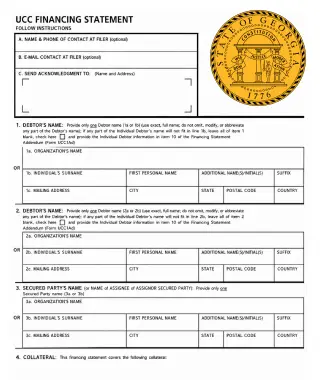
A UCC-1 financing statement is a public notice filed by a creditor to publicly establish their security interest in a debtor's personal property or business assets. It is a registration of debt, not the underlying contract or security agreement itself.
What is a UCC-1 Financing Statement? A Georgia UCC-1 financing statement is a legal form filed by creditors to give public notice that they hold a security interest in a debtor's personal property or business assets to secure a debt. It protects the creditor's priority rights against other creditors in the event of default
Why Does it Give Legal Notice Against Third Parties? It alerts other lenders and the public that a loan or lease already encumbers specific collateral. Under Georgia law, the first creditor to file a valid UCC-1 generally gets "first dibs" on the stated collateral if the borrower defaults or goes bankrupt. The UCC-1 does not create the debt or grant the lien; rather, it serves as the public registration of a separate underlying security agreement (such as a promissory note).
What "Perfecting a Lien" Means and Why it Matters for Creditors: Perfecting a lien is the legal process of converting a preliminary claim (such as a filed lien or mortgage) into a fully enforceable claim against third parties and other creditors. It typically involves an official recording and may require filing a lawsuit to secure your rights. Perfecting a lien officially puts the public (and other lenders) on notice of your claim against a debtor's asset. Simply filing a Claim of Lien on real estate does not automatically grant you the money. Under Georgia lien laws, a creditor must typically perfect the lien by filing an actual lawsuit to foreclose on the property within a specific statutory window. When a lien is perfected, it acts as an encumbrance on the property's title. This heavily discourages the debtor from attempting to sell, refinance, or transfer the property, as the new owner would take the property subject to their lien.
Where Most Georgia UCC Filings Go: Most Georgia Uniform Commercial Code filings go directly to the Clerk of Superior Court in any of Georgia's 159 counties. Regardless of which local county clerk receives the document, they are all mandated to transmit the records to the Georgia Superior Court Clerks' Cooperative Authority. This state office aggregates all the data within 24 hours. Filers are not required to pick a specific county. You can submit your documents to any Superior Court Clerk's office, though creditors often file in the county where the debtor is located or where the collateral resides.
The Exceptions: Real estate and fixture filings are filed with the county, but not the court system.
What a GA UCC Search Reveals

A UCC filing in Georgia search reveals any active liens or claims placed on a person's or business's personal property or assets when used as collateral for a loan. It establishes which creditors hold priority claims in the event of default. The data revealed is as follows:
Debtor Name & Address - The exact legal name and address of the individual or business entity that pledged the collateral.
Secured Party Name - The exact name and address of the lender or creditor holding the security interest.
Collateral Description - A written description of the assets used to secure the loan (which can range from broad categories like "all inventory and equipment" to highly specific items with serial numbers).
Filing Date - The file number (instrument number), along with the exact date and time the UCC financing statement was filed. The filing date establishes priority among multiple creditors.
Lapse Date - Shows the date the filing will expire, which is typically 5 years from filing, after which an unfiled continuation means the lien is dead.
Filing Number - A unique ID designated by the local court for retrieving certified copies or tracking amendments.
Amendments / Terminations - The complete list of amendments or a termination indicating that the lien is paid off. These UCC-3s show whether the filing has been modified, extended, or released.
Assignees - Shows whether the original secured party has transferred its interest to another entity.
Why Do UCC Filings Matter in Georgia?

Uniform Commercial Code filings matter in Georgia because they act as public notice that a creditor has a secured interest in a debtor's personal or business property. They are essential for protecting lenders, establishing loan priority, and driving commercial financing across the state. Georgia simplifies the filing process through a statewide index. Instead of having to file a security interest in all 159 counties to protect a lien, a lender files with the GSCCCA or the local clerk to receive statewide notification and priority. For businesses in Georgia, UCC filings are crucial for securing capital. Lenders are significantly more willing to extend credit or issue equipment loans when they have a legally recognized, enforceable way to recover their collateral if needed. UCC filings are public records that anyone can search through the Georgia Superior Court Clerks' Cooperative Authority. This prevents buyers from unknowingly purchasing assets (such as equipment or business inventory) that still have outstanding liens or debts attached.
Georgia is a very high-volume state for UCC filings, and fixture and real estate liens are recorded with other local offices, making searches complex. Georgia-based lenders file UCC-1s against borrowers nationwide. When searching for liens, it's crucial to include Georgia as a search jurisdiction even for out-of-state debtors. Real estate transactions, co-op purchases, mergers, and acquisitions due diligence in Georgia require UCC searches to identify target companies and their secured creditors, minimizing risk.
How to Run a GA UCC Search

Follow the detailed steps below to perform a thorough UCC filing in Georgia search.
Step 1: Identify the Correct Debtor Name
When performing a UCC search in Georgia, you must search by the exact legal name of the debtor (whether an organization or an individual), file number, or by date and county. Before you begin your search, check official records such as the company's formation documents (not the Certificate of Good Standing) or, for individuals, the person's driver's license to obtain the exact legal name. The Georgia Superior Court Clerks' Cooperative Authority does not use any fuzzy matching, meaning that if you use even a small variation (wrong middle initial, DBA abbreviation, or comma placement), you may see zero results even when there are active filings. When searching for individuals, you must use the proper legal format (Last, First, Middle).
Step 2: Choose Your Search Method
A UCC search in Georgia offers you three main options. You can search via the Georgia Superior Court Clerks' Cooperative Authority using its free UCC Index tool. You can use the Basic Name Search, search by file number, specific date, county, or secured party, or use the certified tool to request a certified copy. The free search provides basic, uncertified information that is adequate for initial due diligence or research, but not for official transactions. When ordering certified copies, you must pay a per-copy fee. If time is not an issue, you can also search UCC records in Georgia by mail. To do so, you must submit a UCC-11 Information Request form along with the required fee to the Georgia Superior Court Clerks' Cooperative Authority. The fee is $15 per debtor name, and you can mail it to: UCC-11 Information Request, 1875 Century Blvd., Suite 100, Atlanta, GA 30345. You can also use an authorized search service to search both state and county records simultaneously, so you don't miss any liens that may be filed with another local county or agency.
Step 3: Review the Search Results
During a UCC search in Georgia, you must review the results carefully. Examine each filing you see and confirm the debtor's name; match it to the correct debtor you are searching for, and ensure it is not a similar/coincidental match. Check the collateral description and match that to the assets that are encumbered. Pay close attention to where it says, "all assets", as this means all current and future assets may be encumbered. Verify the secured party's identity as well and check the lapse/filing dates to confirm that the filing is current and accurate. Check all amendments and continuations. Some alter the collateral or add additional parties; others may continue a filing or terminate it when it is paid off. Finally, note any assignments where the lien holder transfers it to another party.
Step 4: Obtain Certified Copies If Required
Certified copies of Uniform Commercial Code filings in Georgia are typically required only when official, government-authenticated proof of a filed document is necessary. That applies to litigation when submitting the document as evidence in a court proceeding. Certified copies are also needed when registering or qualifying your Georgia-based business to operate in another state. Real estate closings are another example of when you need certified copies to provide verified proof of lien statuses or terminations to investors, lenders, or escrow officers during major corporate mergers or loan closings. Non-certified results from the free Georgia Superior Court Clerks' Cooperative Authority search portal are fine for preliminary lender review or internal due diligence, but not for official purposes. Be sure to order certified copies early, as they can take 1-3 business days to arrive. You must also pay a fee for certified copies.
GA UCC Search for Out-of-State Businesses
Under the Uniform Commercial Code in Georgia, creditors generally must file financing statements in the state where the debtor's business is legally organized or incorporated. For an out-of-state business, this means you typically search and file in the state where the business is headquartered. This centralizes all UCC records in the debtor's home jurisdiction and is called "the jurisdiction rule".
However, Georgia still matters for out-of-state debtors because a creditor might need to file a "fixture filing" if the business owns real estate or property in Georgia. Furthermore, if an out-of-state business is officially registered to do business in Georgia, it generally consents to state jurisdiction. This means the debtor can be sued in Georgia courts.
To perform a search, you can use the Georgia Superior Court Clerks' Cooperative Authority to check statewide records. When filing a lien against out-of-state assets located in Georgia, you can submit your forms to any county clerk's office, but be sure to use the correct Georgia UCC Forms to ensure your security interest is properly perfected.
UCC Forms and Filing Duration in Georgia

In Georgia, UCC filings are primarily handled by the Georgia Superior Court Clerks' Cooperative Authority. The state accepts standardized, IACA-approved national UCC forms, which must be the revised 2023 versions. These forms are used to establish, modify, or search for a secured creditor's claim on collateral.
UCC-1 (Financing Statement): The initial filing that perfects a security interest, officially placing a lien on a debtor's personal property. It announces a creditor's claim on collateral to secure a loan.
UCC-1Ad (Addendum): An attachment used along with the UCC-1 if there are additional debtors, multiple secured parties, or if more space is needed to describe the collateral.
UCC-1AP (Additional Party): An add-on form specifically used when you need to list additional secured parties or debtors that exceed the space provided in the UCC-1 and UCC-1Ad forms.
UCC-3 (Amendment/Continuation): Used to alter an existing UCC-1 filing. It is used for various actions, including continuations (to renew a filing for another 5 years), terminations (to release the lien when a loan is paid off), and assignments, additions, or deletions of a debtor or a secured party.
UCC-3Ad (Termination): Used in conjunction with a UCC-3 amendment to provide additional information, such as extra collateral descriptions or newly added parties.
UCC-3AP (Additional Party): An extra attachment to specifically name additional parties being added or removed during an amendment process.
UCC-5 (Correction Statement): Filed by a debtor who believes that a UCC record indexing an interest against their property is inaccurate or wrongfully filed. It places a note on the record to explain the debtor's perspective, though it does not invalidate the underlying lien. Used to notify the public that a person is claiming an interest in a record, similar to a correction statement.
UCC-11 (Information Request): Used to request an official, certified search of the statewide UCC index maintained by the GSCCCA. This reveals any active liens filed against a specific individual or business entity.
Filing Officer Statement: An administrative form used by the state filing office for specific official actions.
UCC Notice of Refusal: Sent by the filing office to notify the submitting party that a UCC filing has been rejected and provide the reasons why.
How Long Are Georgia UCC Filings Effective?

As a general rule, in Georgia, UCC financing statements are effective for 5 years from the date of filing, but certain situations can alter that date.
Standard Lapse: Five years from the filing date. A lien with no continuation filed before the lapse date is extinguished.
Continuation: A UCC-3 continuation must be filed within the 6-month window before the lapse date to extend the effectiveness for another 5 years. Outside this window, a continuation is ineffective. There is no limit to the number of continuations a creditor can file as long as the debt remains outstanding.
Deceased Debtor: In Georgia, a UCC financing statement remains effective for 5 years from the date of filing, even if the debtor dies. The death of an individual debtor does not shorten the lifespan of the UCC filing, nor does it automatically perfect or extend it beyond the standard five-year window.
Manufactured Homes: While other states offer exceptions allowing 30-year or indefinite terms for specific entities, such as manufactured homes, Georgia does not provide uniform exceptions. All UCC filings in Georgia adhere to the standard 5-year duration regardless.
Fixture Filings: If the UCC filing serves as a fixture filing and is recorded as a security instrument in the real estate records, it generally remains effective for the duration of the real-property recording (or until it is released/satisfied).
Transmitting Utilities: Unlike most other states, where "transmitting utility" filings remain effective indefinitely, Georgia is an exception. Georgia adopted a non-uniform version of Section 9-515, which provides that utility filings lapse after 5 years unless continued. Searchers should not assume these filings are automatically active simply because of the utility status.
"All Assets" Lien: Georgia UCC filings are generally effective for five years from the date of filing, regardless of whether the collateral is listed as "all assets" (a blanket lien) or specific property. The "all assets" language refers to the collateral covered, not the duration.
What Happens When a GA UCC Filing Lapses

When a UCC-1 lapses without a continuation filed during the valid window, the security interest becomes unperfected as a matter of law. The original secured party does not automatically retain its prior rights. To re-perfect, they must file a brand-new UCC-1, which resets their priority clock to the new filing date. This has a direct impact on lien searches: a searcher who finds a filing with a past lapse date must check whether a continuation was filed before that date. This is important to note when searching. Never assume a past-lapse-date filing is irrelevant without verifying whether a continuation has been filed to keep it active.
UCC Lien Priority Explained
In Georgia, UCC lien priority generally operates on a "first to file" basis, meaning the initial creditor to record a financing statement has the primary claim to the debtor's assets. If a borrower defaults, this first-position creditor is paid from the collateral before junior creditors are paid.
Priority complications arise because they are determined by the first to file or perfect, and special "super-priority" liens, such as certain property taxes or Purchase Money Security Interests (PMSIs) for equipment, which can jump ahead of older, filed liens. Furthermore, Georgia handles UCC filings at the local county level rather than a single central state database.
Thorough searching is crucial to identifying prior claims and ensuring security interests are protected. Reviewing these public records reveals existing claims to a business's collateral, their priority status, and whether those claims are properly filed. Proper due diligence is essential for lenders, researchers, and businesses.
Who Needs a GA UCC Search
Professionals conducting a UCC search in Georgia are checking public records for "liens" (claims) placed on business assets, such as equipment or inventory, by lenders. This prevents financial surprises by revealing whether another party already has a claim to a company's assets. Some details about the types of professionals who need this service are as follows:
Lenders and Financial Institutions

Before providing a business a loan, commercial banks, asset-based lenders, factoring companies, and equipment lenders all check UCC records to see if the company's assets are already pledged as collateral to other creditors. These professionals cannot risk extending credit or advancing funds against collateral that a superior creditor already encumbers. It would mean they were instantly subordinated and might not be repaid if the borrower defaulted or filed for bankruptcy. Lenders use thorough due diligence, including UCC searches in Georgia, to reveal any hidden liens and creditors. To streamline the process, many use EntityCheck, which combines both state and county records to provide a more complete picture.
Attorneys and Legal Professionals

Venture capitalists and private equity buyers search UCCs to evaluate a target company's debt burden and true financial standing before investing. Similarly, M&A, bankruptcy, and litigation attorneys use UCC searches to identify encumbrances on judgment debtors or to identify creditors during bankruptcy. Attorneys run these searches during "due diligence" for mergers, acquisitions, or real estate deals to verify a company's legal and financial health. Failing to identify undisclosed secured creditors during a pre-closing search could destroy the deal or, worse, create a problem after closing. As these liens can affect credit priority schedules, anyone with financial risk must find out who is ahead of them. EntityCheck makes searching UCC records effortless by combining databases from state and county offices, so you can search once and see everything.
Businesses and Buyers

Companies that lease heavy machinery or expensive technology to other businesses check UCC records to ensure another lender doesn't falsely claim their leased assets. Individuals buying a franchise or existing company use UCC searches to determine if any of the assets/equipment is already encumbered, so they don't inadvertently inherit a lender's collateral claim. Business owners also use UCC searches in Georgia to check their own status before borrowing money. Sometimes liens appear in the records even though they are paid off. Since lenders will also see these filings, a business owner can avoid issues by investigating and addressing any problems that arise during the financing process. To get the full picture during due diligence, use EntityCheck, which aggregates data from multiple sources to show all types of liens, including UCC filings, federal liens, judgment liens, agricultural liens, fixture filings, and mechanic's liens.
Real Estate Professionals

Real estate professionals and title attorneys in Georgia use UCC searches primarily to identify non-real estate liens (such as equipment or business inventory) that could impact a commercial transaction. Because UCC security interests can attach to fixtures (items bolted or built into the building, like HVAC systems or elevators), these searches are crucial for risk management. During the acquisition or refinancing of commercial properties (such as hotels or apartment complexes), real estate attorneys run UCC searches on the borrowing entity. This reveals whether the business's assets (like furniture, fixtures, and accounts receivable) are pledged as collateral to another lender. Title examiners use UCC searches to check the exact legal name of the debtor. Finding active UCC filings helps buyers and lenders determine whether any other secured creditors have priority claims, ensuring the new buyer receives a clear title to the property. It can be challenging to locate all liens against a property, but using EntityCheck makes it much simpler. One search reveals all types of liens.
Individual Debtors and Business Owners

Individuals also use UCC searches in Georgia to conduct financial due diligence, verify the clean title of collateral, and protect their credit profiles. These searches reveal whether any existing liens or "blanket pledges" are tied to personal or business assets, or whether a terminated lien still appears as active. When buying a business or taking on partners, individuals search the registry to uncover hidden debts or encumbrances tied to the entity's assets. Buyers of co-op apartments, heavy equipment, boats, or aircraft perform UCC searches to ensure they are not purchasing property that serves as collateral for someone else's unpaid loan. Since unterminated liens can block new financing, individuals can use this UCC search tool to ensure their borrowing history is clean and ready for new funding.
Georgia-Specific UCC Considerations

Georgia has a few unique twists on the Uniform Commercial Code that set it apart from most other states. Understanding these Georgia-specific rules is essential for lenders and businesses to protect their interests, enforce collateral claims, and navigate public records properly. Some of the items that set Georgia apart are:
"County" Filing Rule
In most states, UCC financing statements (UCC-1s) are filed centrally with a single state office, like the Secretary of State. Georgia does not use the Secretary of State for UCC filings. Instead, filings are made at the local county level and are handled and indexed by the Georgia Superior Court Clerks' Cooperative Authority. Because the state requires filings to be filed locally but managed centrally, you do not have to guess which county the debtor lives in or where the collateral is. You can submit standard personal property filings (like business assets) to any of Georgia's 159 county Superior Court Clerk's offices. The county will accept it and immediately forward it to the GSCCCA for entry into a statewide database.
E-Filing Standard
While you can still walk into a physical courthouse to file a paper form, Georgia has fully embraced electronic filing. Lenders and businesses can use the official GSCCCA e-Filing System to easily submit UCC-1s and UCC-3 amendments and search for records online. This prevents delays and ensures the data is correctly cataloged in the statewide database.
"Fixture" and "Real Estate-Related" Exceptions
As a rule, UCC filings for personal property are handled at the county level. However, if your collateral is tied to real estate, the rules change. If your collateral includes items that are attached to or will become part of a real estate property (like heavy equipment, HVAC units, or plumbing), you must file a "fixture filing" directly in the real estate records of the county where the property is located. This real estate requirement also applies to "extracted collateral" (like oil and gas) and timber to be cut.
Getting the Debtor Name Right
This is the most common mistake made in UCC filings, and in Georgia, courts are strictly literal. For businesses, you must use the exact legal name listed on the business's current articles of incorporation or organization. Do not use "DBAs," trade names, or nicknames. If you get it wrong, a future creditor may not be able to find your lien, which could wipe out your priority status. For individuals, experts recommend pulling the name exactly as it appears on their driver's license or official government-issued ID to avoid ambiguity.
GA Co-Op Financing and UCC Filings
Georgia co-op financing allows you to buy a share in a housing cooperative rather than the physical property itself. Because you technically own personal property (shares) and a proprietary lease instead of real estate, lenders use a UCC-1 filing to secure their loan and attach to the lease and shares as collateral. This prevents you from borrowing against those same shares elsewhere. When you buy a co-op, you are not buying a traditional house or condo. Instead, you are buying shares in a corporation that owns the entire building, which gives you the exclusive right to live in a specific unit. Because you do not own "real estate," you cannot take out a traditional mortgage. Instead, you get a share loan (co-op loan). Because co-op shares are legally considered "personal property" (not real estate), lenders do not record a standard mortgage on your property. Instead, they file a Uniform Commercial Code financing statement, specifically a UCC-1. The UCC-1 is an official public record that tells everyone your lender has a "security interest" in your co-op shares. It guarantees that your lender is first in line to be paid back from those shares if you fail to make your loan payments. Co-op filings are filed with the Clerk of the Superior Court in any county in Georgia. If your loan lasts longer than 5 years (which it likely will), your lender will file a UCC-3 continuation statement before the 5-year mark to keep the lien active. Lenders must know where in Georgia to search for UCC liens to ensure the shares and lease are free to encumber.
Agricultural Liens in Georgia
Georgia agricultural liens protect people who provide essential goods, services, land, or labor to farmers. They allow the creditor to place a lien on the farmer's crops, livestock, or equipment to ensure payment if the farmer defaults on a debt. Georgia law (OCGA Title 11 & Title 44) provides different types of agricultural liens depending on the creditor. If you lease land to a farmer, you automatically get a lien on the crops grown on that property to secure the rent and any farming supplies you provided. Farmworkers have a special lien on the products of their labor (e.g., the crops they harvested or animals they raised) to guarantee they receive their wages. Mechanics who repair farm machinery or equipment have a lien on that equipment for the cost of their labor and materials. People who board, feed, or care for livestock hold a lien on the animals to ensure payment for their services. With agricultural liens, the attachment happens automatically as soon as the conditions are met (e.g., you supply the seed, or the mechanic repairs the tractor). The lien now legally "exists." To ensure your lien is prioritized over other creditors (like a bank), you usually must file a financing statement with the Georgia Superior Court Clerks' Cooperative Authority in the county where the property or farm is located. If you do not officially record or "perfect" the lien, another lender with a recorded lien may get paid first. Liens do not last forever. If a farmer does not pay, the creditor must take legal action to "foreclose" on the lien. In Georgia, lienholders usually have 365 days from the date the lien was filed to begin a formal legal enforcement or foreclosure action. If this strict deadline is missed, the lien expires, and the right to collect is lost.
Federal Tax Liens - A Separate Search Required
Federal tax liens are an entirely different animal. A federal tax lien is the government's legal claim against your property when you fail to pay a tax debt. It acts as public notice to other creditors that the IRS has a right to your assets. It interacts with UCC filings through a strict "first in time, first in right" priority system. When you owe taxes, the IRS assesses your liability and sends you a bill. If you ignore it or do not pay in full, an automatic lien is created on all your current and future property, including real estate, vehicles, and business assets (such as inventory and accounts receivable). To protect its claim against other creditors, the IRS will file a public document called a Notice of Federal Tax Lien. Liens generally follow the "first in time, first in right" rule. Whichever document (the UCC or the Tax Lien Notice) was properly filed first usually has priority over the other for the assets. Keep in mind that when searching for liens, federal tax liens do not show up in UCC filings. They are typically filed with the local county office, not the courts or the state. You must search both county and state records for a complete picture.
Judgment Lien vs. UCC Lien
A judgment lien is a non-consensual, court-ordered claim placed on a debtor's property after a successful lawsuit. Unlike UCC liens, which are voluntary agreements mostly tied to personal property or business assets to secure a loan, judgment liens are involuntary and typically attach to real estate.
To search for judgment liens in Georgia, you can use the Georgia Superior Court Clerks' Cooperative Authority platform. This centralized, statewide database allows you to look up lien records and civil judgments across all 159 Georgia counties.
Understanding the difference and conducting these searches (to find both types) is essential for protecting your property rights and assessing financial risk in Georgia.
Georgia UCC Search - Common Mistakes to Avoid

Conducting an effective Georgia UCC search requires using exact debtor names and the state's standard search logic. The most common mistakes to avoid are searching only exact matches, using DBAs or trade names, ignoring former names, and failing to perform post-filing searches to verify your lien was indexed correctly.
Searching only the Georgia Department of State database and missing county-level fixture filings - In Georgia, UCC filings (including fixture filings) are submitted at the local county level, which can cause searchers to believe they must visit individual county offices. However, local superior court clerks have 24 hours to transmit filings to the state's centralized system. To capture liens across all 159 Georgia counties, search the statewide index through the Georgia Superior Court Clerks' Cooperative Authority.
Using an incorrect or abbreviated debtor name variation - UCC search logic is highly sensitive to punctuation, spacing, and ending noise words (e.g., Inc., LLC, LP, Corp). The most common fatal mistakes include using an ampersand (&) instead of the word "and", omitting, or misspelling words (such as changing "Manufacturing" to "Mfg".), including extra spaces or missing required spaces, or adding extra information (such as titles or capacity) that shouldn't be part of the legal name. These can lead to incorrect results.
Assuming a filing past its lapse date is automatically extinguished - UCC-1 financing statements are only effective for five years. If a secured party fails to file a continuation statement during the six-month window before the expiration date, the filing will lapse. If it lapses, the secured party effectively loses its original priority status and becomes an unperfected creditor. Don't miss UCC-3 statements, which continue the filing for another five years.
Failing to search all debtor name variations - Many professionals assume searching the exact name found on a formation document covers all bases, but this often leads to missing prior filings. Slight abbreviations, punctuation variances, or "Doing Business As" (DBA) names can result in undiscovered filings. Best practice dictates that you run searches for common variations, initials, former names, and any DBAs the debtor may operate under.
Not ordering certified copies when the transaction requires them - Keep in mind that non-certified online results are not accepted for court filings or real estate closings; substituting them can delay closings. You must order certified copies in time for any official proceedings.
Treating a UCC search as a substitute for a federal tax lien search - Federal tax liens are not included in the Georgia UCC database. They are a separate type of lien, and you must search for those as well to find all encumbrances.
Why Use EntityCheck for Your GA UCC Search

Georgia is another very high-volume state for UCC filings, making it a crucial destination for searchers. Not only are most UCC filings recorded with the Georgia Superior Court Clerks' Cooperative Authority, but fixture filings are recorded at the county level with county recorders, and, of course, federal liens are recorded at the federal level. All of this makes a UCC search in Georgia complex, and if you don't search all available databases, you could miss critical liens that affect your company.
Manual searches take time and often money. To perform proper due diligence, you must thoroughly search all locations, which can be time-consuming, confusing, and yet still yield inaccurate results. EntityCheck offers a better, faster solution. Our search tool combines data from all state, county, and federal databases and allows unlimited searches. You get the right information at your fingertips when you need it, without the hassle of going through the Georgia Superior Court Clerks' Cooperative Authority, multiple county websites, and related government agencies. Try a free search today.
FAQ
How long does a Georgia UCC search take?
Conducting an uncertified UCC search online through the Georgia Superior Court Clerks' Cooperative Authority Index is instantaneous. For a formally certified UCC search request submitted via the portal, the standard turnaround time is typically 24 hours.
If you require a certified search certificate by mail or directly from the clerk's office, the processing timeframe for the county clerk to transmit and for the state central index to register is 24 to 48 hours. Processing varies slightly by location, with electronic recordings in larger counties (like Fulton County) processed in 2-3 business days.
How do I search UCC filings in Georgia?
To search UCC filings in Georgia, you can use the statewide index managed by the Georgia Superior Court Clerks' Cooperative Authority. Visit the search portal, create a user account, choose how you want to search, and enter a search string (name) to find records. Review the results. If you want certified copies, pay the $15 fee (per debtor name) and order them online.
How far back do GA UCC records go?
Uniform Commercial Code records in Georgia, available in a central statewide index, generally date back to January 1, 1995. Before 1995, UCC financing statements had to be filed in all 159 counties in Georgia. Standard UCC filings are effective for only 5 years unless a continuation statement is filed. Consequently, historical filings from the 1990s and early 2000s have long lapsed unless periodically renewed.
What is the difference between a state and a county UCC search?
In Georgia, a state-level UCC search accesses a centralized database covering all 159 counties. In contrast, a county-level search looks for records physically filed or recorded in a specific local jurisdiction. Unlike most states that use a Secretary of State, Georgia handles all Uniform Commercial Code filings and searches through the Georgia Superior Court Clerks' Cooperative Authority. However, if your UCC search involves "fixtures" (collateral attached to real property, such as HVAC units), you must perform the search in the specific county where the real estate is located, as these require physical land records for perfection.
How do I remove or terminate a UCC lien in Georgia?
To terminate a UCC lien in Georgia, you must file a UCC-3 Financing Statement Amendment, checking the "Termination" box. Once your debt is paid in full, contact your secured party (lender) and request that they file a UCC-3 termination statement. They are legally obligated to file a termination generally within 20 days of receiving a written demand from you. Always request a stamped copy of the filing for your records. If the lender refuses or fails to file the termination, you can file it yourself under O.C.G.A. § 11-9-513.
Are Georgia UCC filings public record?
Yes, Georgia Uniform Commercial Code filings are public records. The state maintains a centralized database that indexes these financing statements, which notify creditors that an interest is held in a debtor's assets. You can access and search these records in person or online.
Do I need a UCC search for a Georgia co-op apartment purchase?
Yes, you need a Uniform Commercial Code search when buying a co-op apartment in Georgia, because you are purchasing personal property (shares in the cooperative and a proprietary lease) rather than traditional real property. A UCC search ensures the shares are free and clear of outstanding liens from previous owners.
What is a UCC-1 vs. a UCC-3 in Georgia?
A UCC-1 is the initial financing statement used to publicly record a lender's security interest in a borrower's business assets. A UCC-3 is the amendment form used to alter, extend, or terminate the existing UCC-1 record.
Can I search UCC filings by a secured party?
Yes, you can search Georgia UCC filings by a secured party. You can search the Georgia Superior Court Clerks' Cooperative Authority index by entering specific secured party names or by searching within a specific date range and county.
What counties in Georgia require a separate UCC search?
No county in Georgia requires a separate, standalone county-level UCC search. Georgia uses a centralized UCC filing system. Standard UCC financing statements are filed with the local Clerk of Superior Court in any of Georgia's 159 counties, and the data is immediately transmitted to a unified statewide index. This means a single statewide search will reveal all personal property filings, regardless of the county in which they were submitted.
How much does a GA UCC search cost?
A Georgia UCC certified search costs $15.00 per debtor name submitted. The Georgia Superior Court Clerks' Cooperative Authority handles UCC searches statewide. You can submit and pay for your search online or by mail.
Is a UCC search the same as a title search?
No, a Georgia UCC search is not the same as a title search. They serve entirely different purposes and cover different types of property. A UCC search searches for public notices (UCC-1 financing statements) that show lenders have a security interest in business or personal property used as collateral for a loan. A title search searches historical public records to verify the legal ownership of specific real estate (land and permanent buildings) and to check for any mortgages, taxes, or encumbrances attached directly to that property.